- 6%
- Purchase tax on land that is not a residential apartment
- 18%
- VAT, when the seller is a dealer
- 50%
- Betterment levy, on the rise in value caused by a plan
- 25%
- Capital gains tax for an individual, on the real gain
The map: which tax you pay and at which stage
Every stage in the life of the investment has its own tax. The table sums up the picture, and the chapters after it go through each row.
| Stage | The tax | How much | Who pays |
|---|---|---|---|
| Purchase | Purchase tax | 6% of the deal value | The buyer |
| Purchase from a dealer | VAT | 18% on the price | The buyer, as part of the price |
| Plan approval and realization | Betterment levy (hetel hashbacha) | Half the rise in value | Whoever owned the land on the day the plan was approved |
| Sale | Real-estate capital gains tax (mas shevach) | 25% of the real gain, for an individual | The seller |
| Gift to a relative | Reduced purchase tax | A third of the regular tax: 2% on land | The recipient of the gift |
| Inheritance | No tax on the transfer | 0 | The tax is calculated when the heir sells |
Purchase tax: 6% from the first shekel
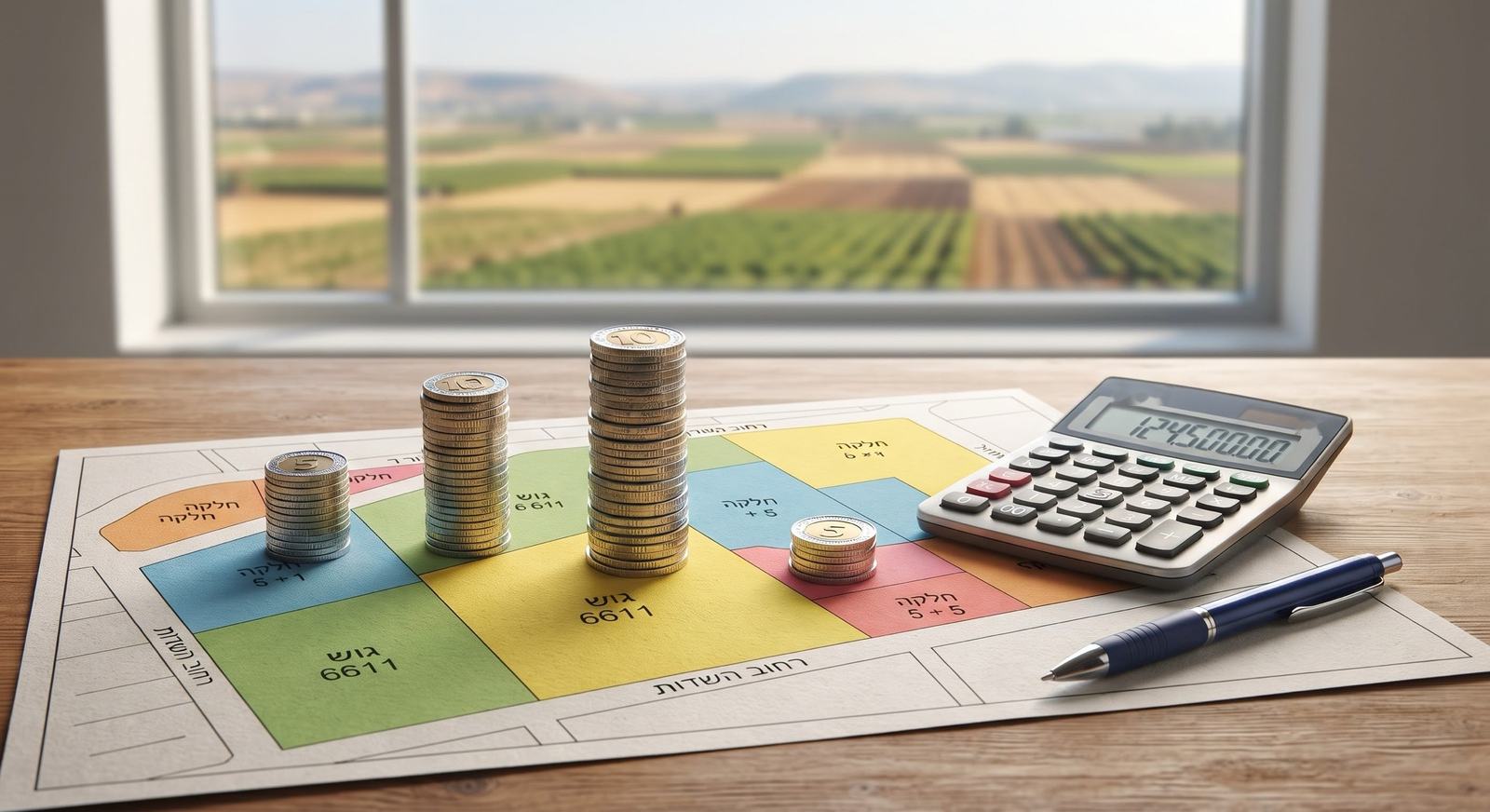
When you buy land that is not a residential apartment, purchase tax is 6% of the deal value. There are no brackets, and the single-apartment exemption does not apply. Agricultural land is also land that is not a residential apartment, so the rate is 6%.
- Deadlines: you file a declaration within 30 days and pay within 60 days of the transaction date. The signing date is the transaction date.
- A share in land: someone who buys a share in land pays only on their share.
- 5% instead of 6%: on land with a residential plan, if a permit for an apartment is issued within 24 months, you can ask for a correction to 5%.
- Value: if the Tax Authority thinks the price in the contract is below market value, it can set a higher assessment.
The full article: Purchase tax when buying land.
VAT: it depends on who the seller is
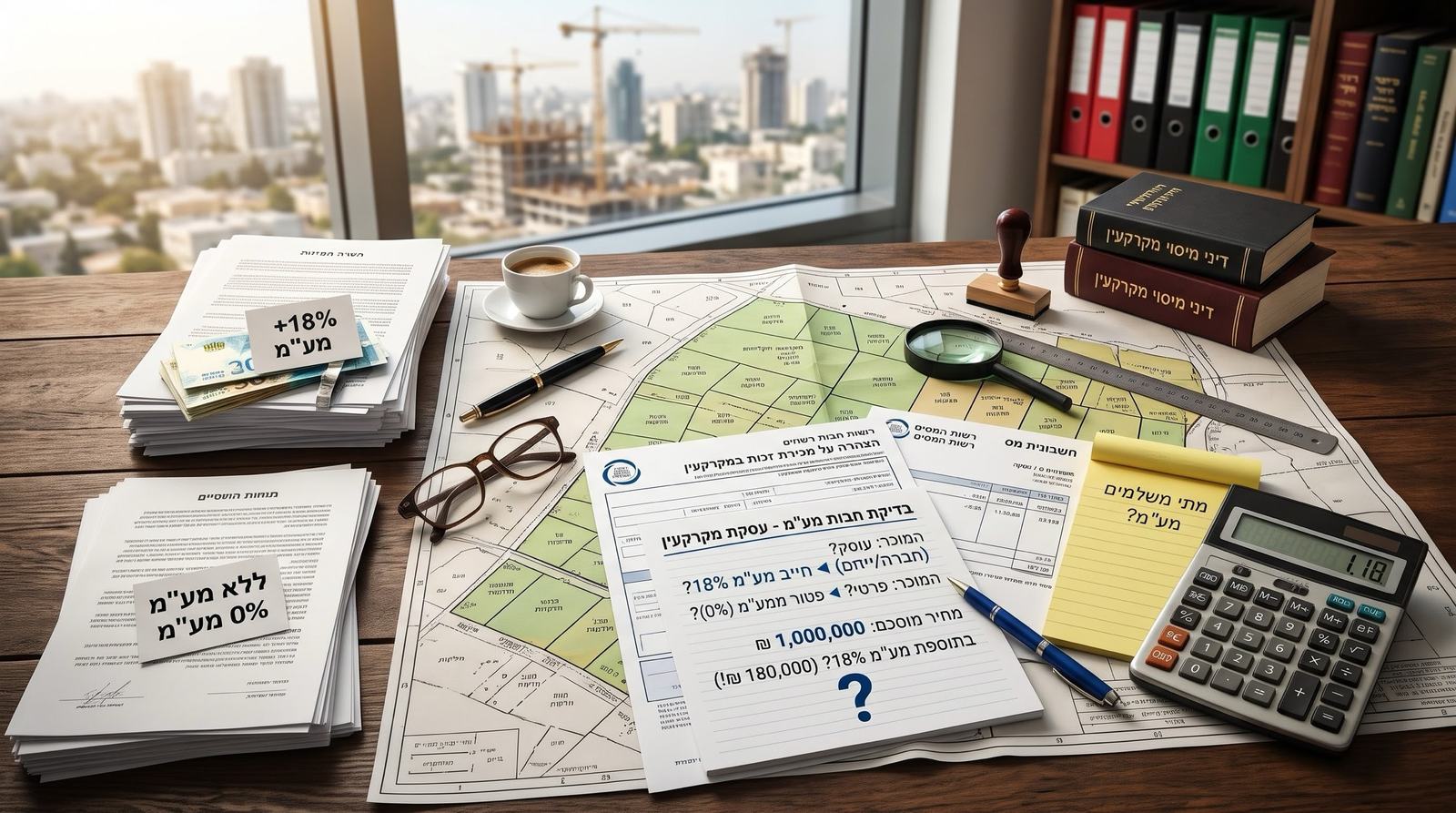
VAT applies when whoever sells the land does so as part of a business: a company, a contractor, or a person who buys and sells real estate systematically. A private person who sells land held as an investment usually does not charge VAT. Since 1 January 2025 the rate has been 18%.
A private buyer does not get the VAT backA licensed dealer who buys land for their business can usually offset the VAT. A private buyer cannot.
VAT increases the purchase taxFor a private buyer, purchase tax is calculated on the whole amount paid to the seller, including the VAT.
On services tooOrganization, support or brokerage fees paid to a business are payments for a service, and VAT applies to them as well.
Before comparing offers, check whether the price in the contract includes VAT or not. The full article: VAT when buying land.
Betterment levy: half the rise in value
When a new plan raises the value of the land, the local authority collects half the rise. Three events create betterment: approval of a plan, a variance (hakala) and non-conforming use. A comprehensive plan usually does not trigger an assessment, because a permit cannot be issued under it.
- Who is liable
- Whoever owned the land on the day the plan was approved. A sale agreement can state that the buyer will bear the levy, but that is an agreement between the parties only.
- When you pay
- When the rights are realized: when the land is sold, when a building permit is received, or when use under the new designation begins. The value itself is set as of the day the plan was approved, and the levy is linked to the index from that day.
- How to appeal
- On the amount, you request the appointment of a deciding appraiser (shamai machria), and on the charge itself you file an appeal with the district appeals committee. There are 45 days to file an objection to the assessment.
For someone buying agricultural land the meaning is simple: if the land rises in value because of a plan, half the rise goes to the authority, and you take that into account in the very first calculation. The full article: Betterment levy.
Capital gains tax: 25% of the real profit
Someone who sells land at a profit pays capital gains tax on the real profit, after index linkage and expenses. An individual who bought from 2012 onwards pays 25%. Land has no single-apartment exemption, even when it is designated for housing.
- 1Sale value
The price you received in the transaction.
- 2Adjusted purchase value
The price you paid, linked to the consumer price index from the day of purchase to the day of sale.
- 3Recognized expenses
Lawyer, appraiser, brokerage and more; these are also linked to the index. They are deducted.
- 4The real gain
What remains: the sale value minus the adjusted purchase value and minus the expenses.
- 5The tax
The tax rate times the real gain.
The tax is paid within 60 days of the transaction date, and the declaration is filed within 30 days. The buyer pays an advance on account of the seller's tax: 7.5% of the price if the seller bought after 7.11.2001, and 15% if before. For land bought before 2012 the calculation is linear, and for part of the period the rate is different. The full article: Capital gains tax on the sale of land.
How the taxes fit together
The taxes do not stand each on its own. Whoever understands the links between them calculates the net profit correctly.
The betterment levy is recognized for capital gains taxA levy that was paid is recognized as an expense in the capital gains tax calculation.
Purchase tax tooPurchase tax is an expense connected with the purchase, and it can usually be deducted in the capital gains tax calculation.
Two taxes in one saleWhen land that has gained value from a plan is sold, you may pay both a betterment levy and capital gains tax. The first goes to the local authority, the second to the state.
Keep every documentThe contract, receipts, fees and payments for planning. Each of them reduces your gain in the future.
Gift and inheritance within the family
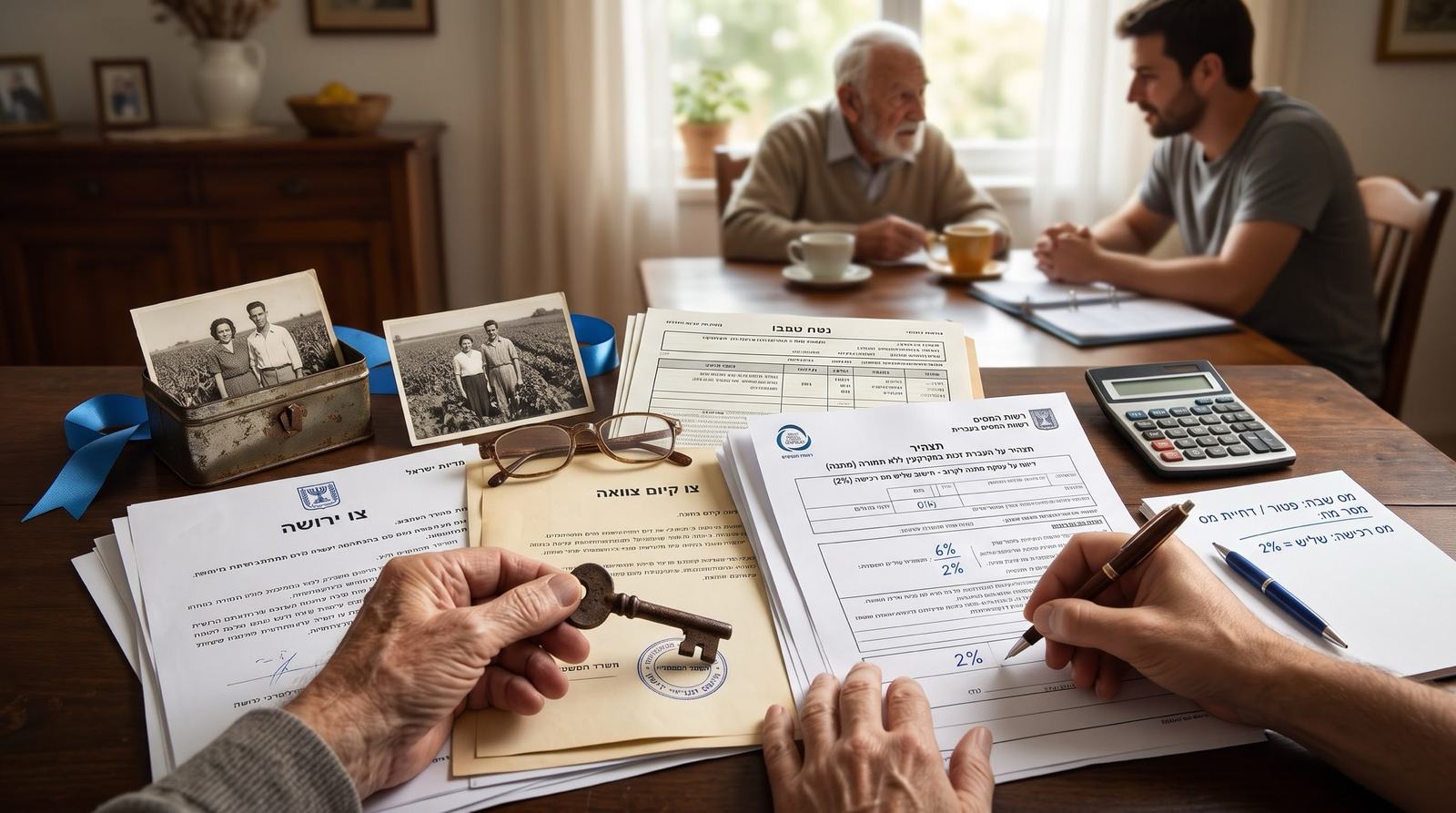
An inheritance is not a sale, so receiving land by inheritance and registering it in the Land Registry (Tabu) pass without capital gains tax and without purchase tax. A gift to a relative is exempt from capital gains tax, and the recipient pays a third of the regular purchase tax: on land that is 2% of the land value, instead of 6%.
An option and a purchase group: tax rules of their own
- Option: Section 49J of the Real Estate Taxation Law sets a track in which the sale of an option is exempt from purchase tax and from capital gains tax, and is subject to tax on capital gains under the Income Tax Ordinance. Purchase tax and capital gains tax are paid when the option is exercised. The conditions are examined in each deal on its merits, with a lawyer. Details: An option to buy land.
- Purchase group: since Amendment 69, in force from 2011, a member of a purchase group for construction pays purchase tax on the value of the finished apartment. A joint purchase of agricultural land as an investment, with no commitment to build, is a different situation, and its classification should be checked with a tax adviser. Details: Purchase group.
The taxes in the budget and in the financing
Calculate the total cost together: price, purchase tax, VAT if any, legal fees and registration costs. Whoever finances the purchase with a loan adds the interest over the whole period, because the repayments do not depend on the success of the planning. Mortgage advisers explain that a mortgage on a plot is usually given only on land already approved for building. On the ways to finance and on the Bank of Israel limits: How to finance buying land.
Checklist: taxes before you sign
- 01What exactly are you buying? Ownership, leasehold or a share of the land. Check the Land Registry extract (nesach tabu).
- 02Check the parcel in ERRA Analytics Search for the block and parcel, see which plans apply to it and at what status, and compare with deals in the area. That way you know whether betterment is expected, and when a levy may arrive.
- 03Who is the seller, and does the price include VAT? A private person, a company or a contractor. State explicitly in the contract whether the price includes VAT.
- 04Calculate 6% and add it to the budget On the share you are buying, by the deal value, and when there is VAT, on the price including VAT.
- 05Is there a betterment levy liability? If the plan has already been approved, check in the agreement who bears the levy, and ask the local committee for information on the liability.
- 06Calculate the net profit After capital gains tax and the betterment levy, and compare it with the alternatives.
- 07Decide who files and when Declaration within 30 days, payment within 60 days.
- 08Get advice before signing With a lawyer or a tax adviser who specializes in real estate taxation.
FAQ
Which taxes do you pay when buying land?
Purchase tax of 6% of the deal value, and if the seller is a dealer, the price also includes VAT of 18%. The betterment levy and capital gains tax come later, at realization and at sale.
Which taxes do you pay when selling land?
Capital gains tax, which for an individual is 25% of the real gain. If the land gained value because of a plan and the betterment levy has not yet been paid, you may pay that too.
What is the difference between the betterment levy and real-estate capital gains tax (mas shevach)?
The betterment levy goes to the local authority and is calculated on the increase in value resulting from a plan. Real-estate capital gains tax goes to the state and is calculated on the profit from the sale. A levy that has been paid is recognized as an expense when calculating the capital gains tax.
Is there a single-apartment exemption on land?
No. The single-apartment exemption does not apply to land, neither for purchase tax nor for capital gains tax.
Do you pay tax on land you inherit?
Not on the transfer. An inheritance is not a sale, so there is no capital gains tax and no purchase tax. The tax will be calculated when the heir sells.
Does VAT affect purchase tax (mas rechisha)?
Yes. For a private buyer, purchase tax is calculated on the full amount paid to the seller, including VAT.
Summary
Four taxes accompany land: purchase tax and VAT at purchase, a betterment levy when a plan raises the value, and capital gains tax at sale. Each of them changes the profit, and some are offset against each other. Calculate all of them before you sign, and keep every document from day one. The guide is current as of November 2026. The information in this article is general, and it is not legal advice or tax advice.
Further reading and tools on the site
Articles
- Purchase tax when buying land
- VAT on land purchases
- Betterment levy
- Capital gains tax on the sale of land
- Transferring land by gift or inheritance
- How to finance buying land
- An option to buy land
- Purchase group
Tools and pages
- ERRA Analytics: all plans and transactions on every parcel
- Land profit calculator
- Glossary
- Our projects
Sources
- 01Kol Zchut: Calculating purchase tax, 6% and 5% for land with a residential plan
- 02Kol Zchut: Paying purchase tax, deadlines and Land Registry clearance
- 03gov.il: Declaration on the sale and purchase of real property, within 30 days
- 04Kol Zchut: 18% VAT from 1.1.2025, licensed dealer and input tax offset
- 05Kol Zchut: Calculating purchase tax, transaction value including VAT
- 06Kol-Zchut: Calculating the betterment levy
- 07Kol-Zchut: Objecting to a Betterment Levy
- 08State Comptroller, 2024: Collection and Use of Betterment Levies
- 09Israel Tax Authority: Guide for sellers and buyers of real-estate rights, 2026
- 10Kol-Zchut: Advance payment of real-estate capital gains tax by the buyer
- 11Kol-Zchut: Recognized Deductible Expenses When Calculating Real-Estate Capital Gains Tax
- 12Bizportal: "Inheritance is not a sale", the heir steps into the shoes of the deceased
- 13Bizportal: one third of purchase tax on a gift to a relative, Regulation 20
- 14Bizportal: the Section 62 exemption is a deferral, stepping into the shoes of the gift giver
- 15Kol Zchut: Real-estate options, conditions and taxation
- 16Midrag: mortgage advisors, mortgage on a lot