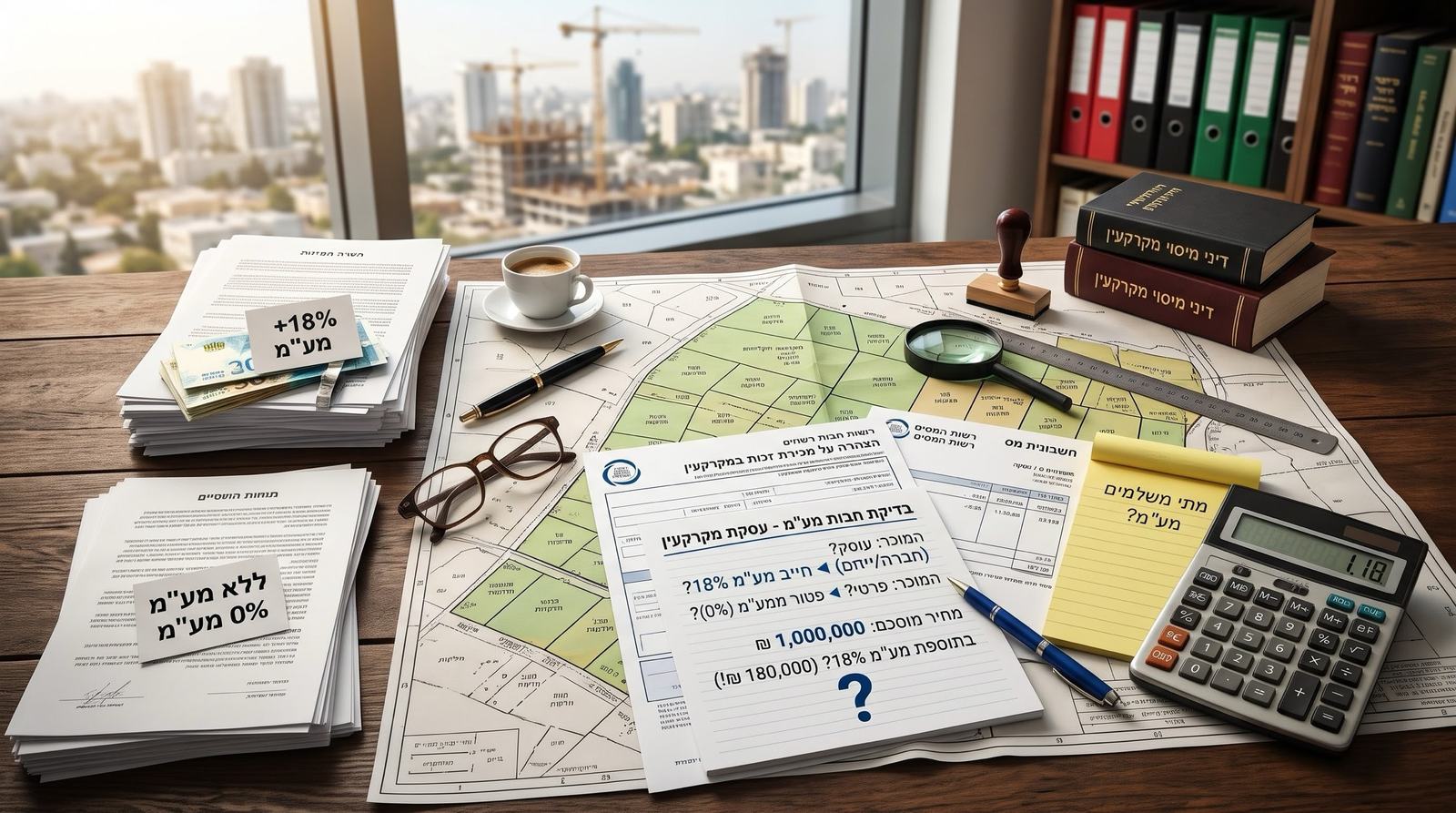
- 18%
- VAT rate since January 1, 2025
- 17%
- The rate until the end of 2024
- 6%
- Purchase tax on land, also calculated on the VAT
When there is VAT and when there isn't
VAT is a tax on a transaction by a business: the sale of an asset or the provision of a service. When a company or contractor sells land as part of its business, the sale is subject to VAT. When a private individual sells land held as an investment, it is usually not subject to VAT. The distinction is not always simple, and the courts examine all the circumstances.
- Selling as a business
- A company dealing in real estate, a contractor, a developer, or a person who buys and sells land on an ongoing basis. The sale is subject to VAT.
- Private individual with an investment
- Someone who bought land, held it and sold it, without any business activity around it. Usually there is no VAT.
- Services
- Organization, support or brokerage fees paid to a business are payments for a service, and VAT applies to them as well.
How the courts decide whether someone is a real-estate dealer
The court looks at the whole picture and relies on several auxiliary tests: how many transactions there were and on what scale, whether the seller improved the property before the sale, how long they held it, whether they marketed it, whether they had professionals or a mechanism for this, how they financed the purchase, and whether the property is unique. Two examples:
Liable: 25 years of buying and sellingThe owner of a meat marketing company claimed he was not a real-estate dealer. The District Court in Lod found a pattern of buying, holding and selling over 25 years, ruled that he was a dealer, and upheld a VAT assessment of about a million ₪.
Exempt: a single sale by a companyIn 2025, the Central-Lod District Court ruled that a land sale by a company engaged in renting out offices was not subject to VAT: it was a single sale, with no improvement and no marketing, self-financed. An assessment of about 622 thousand ₪ was canceled.
How much it costs
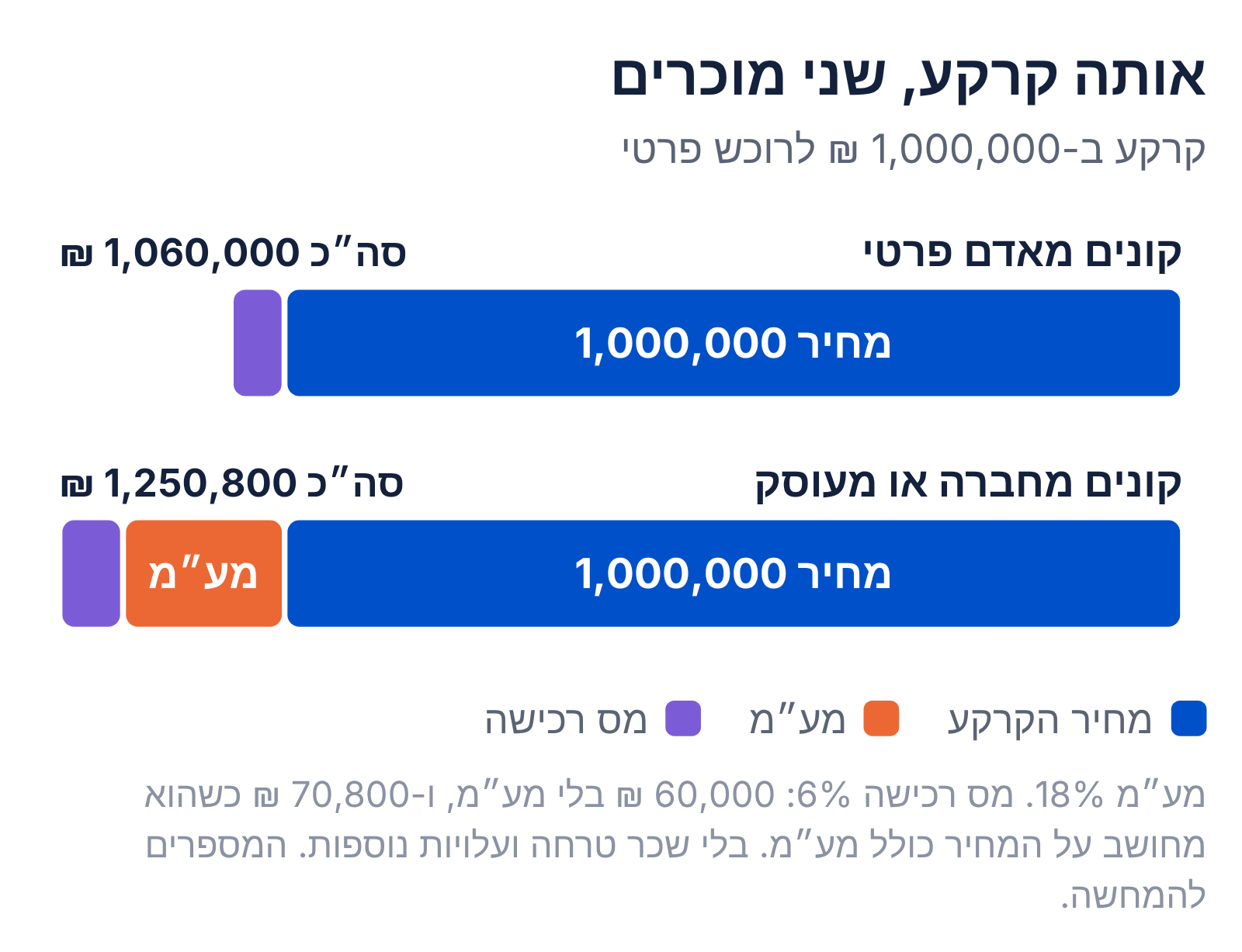
For a private buyer, VAT is a final cost, because they cannot offset it. And for such a buyer, purchase tax is calculated on everything paid to the seller, including the VAT. On purchase tax: Purchase tax on buying land.
Checklist: VAT before you sign
- 01Who is the seller? A private individual, a company or a contractor. The Land Registry extract (nesach tabu) shows who the registered owners are.
- 02Does the price include VAT? State it explicitly in the contract.
- 03Check the parcel in ERRA Analytics. Look up the block and parcel, see which plans apply to it and at what status, and compare with transactions in the area, before and after VAT.
- 04Are there payments for services? Organization, support and brokerage fees: how much, and whether VAT is included.
- 05Calculate the purchase tax. On the price including VAT, when there is VAT.
- 06Consult a lawyer or an accountant. Especially if you are a business yourself.
FAQ
Do you pay VAT when buying land?
When the seller is a business, such as a company or a contractor, yes: 18%. When the seller is a private individual who held the land as an investment, usually not.
What is the VAT rate today?
18%, since January 1, 2025. Until the end of 2024 it was 17%.
Can a private individual be considered a real-estate dealer?
Yes, if they buy and sell systematically. The court examines all the circumstances, such as the number of transactions, the holding period and the marketing.
Does VAT affect purchase tax (mas rechisha)?
Yes. For a private buyer, purchase tax is calculated on the full amount paid to the seller, including VAT.
Can the VAT be reclaimed?
A private buyer cannot. A licensed dealer (osek murshe) buying for their business can usually offset it.
Summary
A sale of land by a business is subject to 18% VAT, while a sale by a private individual who held it as an investment usually is not. For a private buyer, VAT is a final cost, and it also increases the purchase tax. That is why you check who the seller is, whether the price includes VAT, and what you pay for services. The information in this article is general and does not constitute legal advice or investment advice.
Further reading and tools on the site
Articles
- Purchase tax when buying land
- Capital gains tax on the sale of land
- Guide to buying land
- Land Registry extract (nesach tabu)
- Risks of investing in land
Tools and pages
Sources
- 01Kol Zchut: 18% VAT from 1.1.2025, licensed dealer and input tax offset
- 02Efrati: Central-Lod District Court, a land sale that is not a business transaction, and the auxiliary tests (2025)
- 03ynet: Bought and sold real estate for 25 years, and was charged VAT
- 04Kol Zchut: Calculating purchase tax, transaction value including VAT
- 05Meitar: Preparing for the 2025 VAT change, real-estate transactions (PDF)