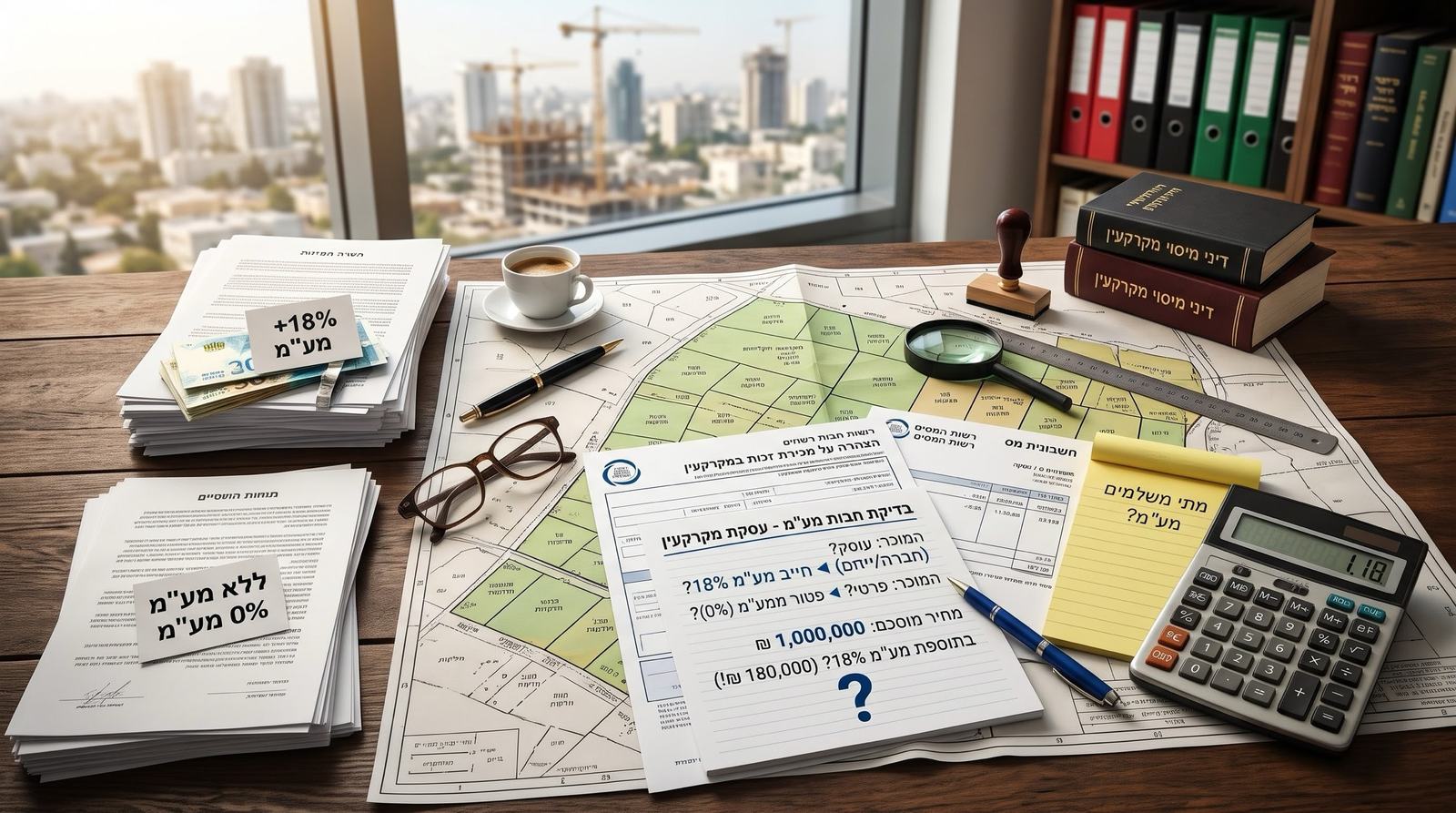
- 50%
- of the increase in value resulting from the plan
- 30
- days to report a realization to the local committee
- 45
- days to file an objection to the assessment
What is a betterment levy
The betterment levy is a mandatory payment to the local planning and building committee. It applies when the value of land rises because of a planning decision, not because of the market. Its provisions are set out in the Third Schedule to the Planning and Building Law.
Three things create betterment:
Plan approvalA plan that changes the land designation or adds building rights, for example agricultural land that becomes residential.
Variance (hakala)Approval to build beyond what the plan permits, for example an additional floor.
Non-conforming useApproval to use the property for a designation other than the one in the plan.
How it is calculated
An appraiser on behalf of the local committee assesses the value of the land twice, as of the same day, the date the plan is approved: once according to the previous planning status, and once according to the new status. The difference is the betterment, and the levy is half of it.
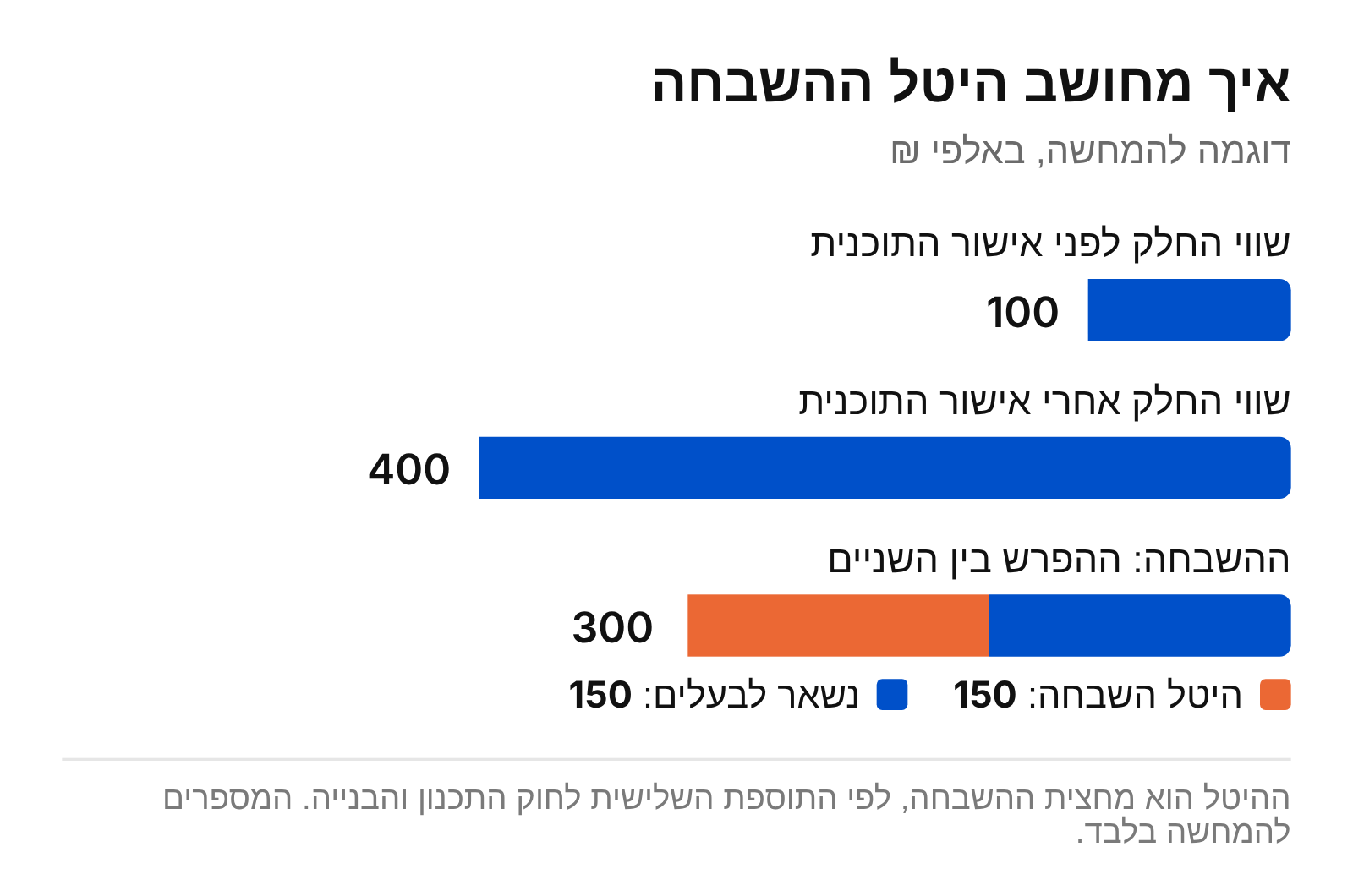
- 1Value under the previous status
What the land is worth under the plan that applied to it before the change.
- 2Value under the new status
What it is worth with the designation and rights the plan granted.
- 3The betterment
The difference between the two values.
- 4The levy
Half of the betterment. From the date of plan approval, it is index-linked.
The general rate is 50%. In urban renewal (pinui-binui) compounds the rate is 25%, and some authorities have set a different rate there. The levy is calculated according to the value on the date the plan is approved, not according to the price at which the land is later sold. This is the main difference from real-estate capital gains tax (mas shevach).
When you pay
The assessment is set as of the date the plan is approved, but payment is deferred until the realization of the rights. Realization is one of the following:
- Sale
- Sale of the land, or of a share in it. A transfer to a relative without consideration is not a realization.
- Building permit
- Receiving a permit that uses the rights granted by the plan.
- Actual use
- Beginning to use the property according to the new designation, even without a sale.
A realization must be reported to the local committee within 30 days, so that interest is not added. Without payment of the levy, or an arrangement for its payment, the committee will not issue a permit and will not approve registration of the buyer in the Land Registry (Tabu).
In one sentenceWhoever held the land when the plan was approved is the one liable for the levy, even if they pay it only when they sell, years later.
Who pays
The landowner, or the long-term leaseholder, on the date the plan is approved. In a sale agreement the parties can agree that the buyer will bear the levy, but toward the committee the liable party is whoever was the owner on the date the plan was approved.
On state land the situation is different: the Israel Land Authority (ILA) transfers to the local authority a payment "in lieu of betterment levy", at a rate of 12% of its receipts.
What this means for buyers of agricultural land
Profit shrinks by half the bettermentIf your land rises in value because of the plan, half of the increase goes to the local authority. Factor this in from your very first calculation.
Also in reparcellationThe betterment is assessed according to what you were allocated in the allocation table, not only according to the original parcel. How reparcellation works.
Payment comes at the endAs long as you have not sold and have not received a permit, you don't pay. But the levy is index-linked from the date the plan was approved.
Ask before you buyIf the plan has already been approved, check in the agreement who bears the levy, and ask the local planning committee for information on the liability.
At which stage the plan creates betterment, and why the price jumps precisely there: Land re-zoning, the 7 stages. The comparison with an apartment, including taxes: Land or an apartment.
Exemptions
The exemptions are limited, and most of them require an application. The main ones:
| Exemption | Main condition |
|---|---|
| Building or expanding a residential apartment | Up to 140 m², and the owner or a relative lives in it for four years after construction is completed |
| Building a safe room (mamad) | Within the minimum required area |
| An area declared by the government | Declaration by order, with the consent of the local authority |
| Evacuation and reconstruction (pinui-binui) | A reduced rate of 25%, or another rate set by the local authority |
How to appeal the assessment
You have 45 days from the date you receive the assessment. The route depends on what you are disputing:
- 01Disputing the liability itself? For example, you claim there is no betterment or that an exemption applies. You file an appeal with the District Appeals Committee.
- 02Disputing the amount? You request the appointment of a deciding appraiser (shamai machria). Both parties pay the appraiser's fee in equal shares.
- 03Need a permit or registration now? During the proceedings you can pay half of the amount and provide a bank guarantee for the balance.
Before appealing, it is advisable to obtain an opinion from a real-estate appraiser acting on your behalf. An assessment of agricultural land depends on assumptions, and two appraisers can reach different results.
FAQ
How much betterment levy do you pay?
Half of the increase in the land's value resulting from the plan, the relief or the non-conforming use. In evacuation and reconstruction (pinui-binui) compounds the rate is 25%.
When do you pay betterment levy?
Upon realization of the rights: when the land is sold, when a building permit is obtained, or when use under the new designation begins. The value itself is determined as of the date the plan is approved.
Who pays the betterment levy (hetel hashbacha), the seller or the buyer?
Whoever was the owner on the date the plan was approved. A sale agreement can stipulate that the buyer will bear it, but that is an agreement between the parties only.
What is the difference between the betterment levy and real-estate capital gains tax (mas shevach)?
The betterment levy goes to the local authority and is calculated on the increase in value resulting from a plan. Real-estate capital gains tax goes to the state and is calculated on the profit from the sale. A levy that has been paid is recognized as an expense when calculating the capital gains tax.
Is a betterment levy payable on a comprehensive plan?
Usually not. The assessment is made when there is a plan that allows a building permit to be issued.
How can you tell whether land is liable for the levy?
Contact the local planning committee and request information on betterment levy liability by block and parcel (gush and helka). You can also request an assessment before a transaction.
Summary
The betterment levy is half of the increase in value that a plan creates. It is determined as of the date the plan is approved, is index-linked, and is paid upon realization. Anyone buying land before a plan must factor it into their calculations in advance. The information in this article is general and does not constitute legal, appraisal or tax advice.
Further reading and tools on the site
Articles
- Change of land designation: the 7 stages
- Guide to buying land for investment
- Reparcellation without the owners' consent
- Right to an apartment: what the term really means
Tools and pages
- ERRA Analytics: all plans and transactions on every parcel
- Land profit calculator
- Economic feasibility calculator
- Presentation: How agricultural land becomes built-up land
- Our projects
Sources
- 01Planning and Building Law, 1965, Third Schedule
- 02Kol-Zchut: Calculating the betterment levy
- 03Kol-Zchut: Exemption from Betterment Levy
- 04Kol-Zchut: Objecting to a Betterment Levy
- 05Tel Aviv-Yafo Municipality: Betterment Levy, Reporting a Realization, and Appeals
- 06State Comptroller, 2024: Collection and Use of Betterment Levies
- 07Kol-Zchut: Recognized Deductible Expenses When Calculating Real-Estate Capital Gains Tax