- 0
- Capital gains tax and purchase tax on receiving an inheritance
- One third
- of the regular purchase tax, on a gift to a relative
- 2%
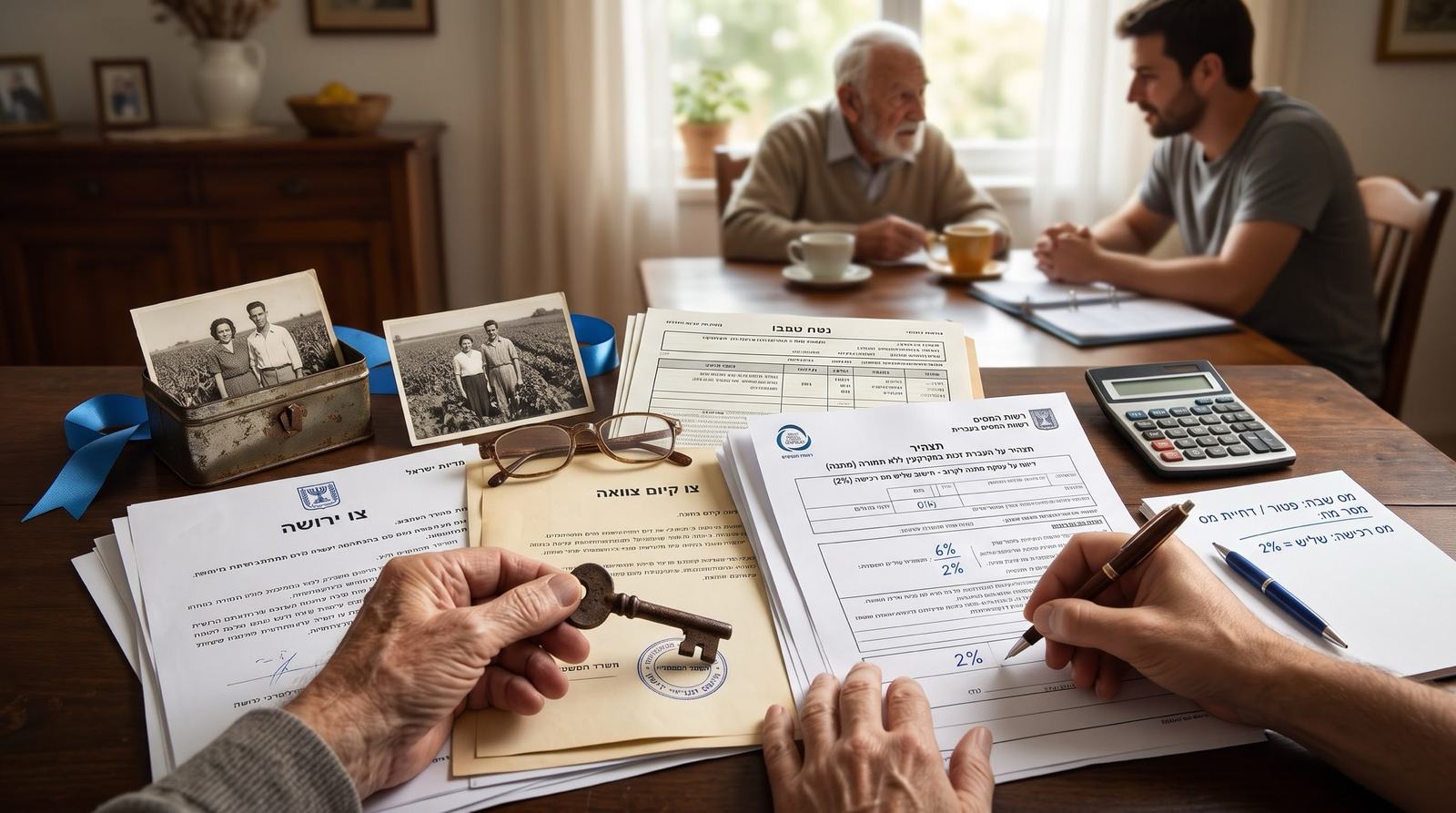
- Purchase tax on a gift of land to a relative: one third of 6%
Inheritance
The Real Estate Taxation Law states that "a bequest is not a sale." Therefore, receiving the land, the inheritance order or probate of the will, and registering the land in the heirs' names at the Land Registry (Tabu) involve no capital gains tax and no purchase tax. The tax event is deferred to the day the heir sells.
On that day, the heir "steps into the shoes of the deceased": the purchase date and purchase value are those of the deceased. If the parents bought the land decades ago for a small sum, the gain will be calculated from that sum.
Gift to a relative
A gift is a sale without consideration, so it is a tax event. But there are reliefs when transferring to a relative:
- Capital gains tax: exempt
- Under Section 62 of the Real Estate Taxation Law, a transfer without consideration from an individual to their relative is exempt from capital gains tax. This is a deferral of the tax, not a cancellation: when the gift recipient sells, the purchase date and value will be those of the giver.
- Purchase tax: one third
- Under Regulation 20 of the Purchase Tax Regulations, a person receiving a gift from a relative pays one third of the regular purchase tax. For land, where the regular tax is 6%, this is 2% of the land's value.
- Who counts as a relative
- For the capital gains tax exemption: spouse, parent, grandparent, descendant, the spouse's descendants, and their spouses. Brothers and sisters only with respect to a right they received from their parents or grandparents. For the one-third purchase tax: spouse, child, grandchild and their spouses, brother and sister.
Comparison
| Topic | Inheritance | Gift to a relative | Regular sale |
|---|---|---|---|
| Capital gains tax on transfer | None | Exemption | The seller pays on the profit |
| Purchase tax on transfer | None | One third of the tax: 2% for land | 6% for land |
| When selling later | Based on the deceased's purchase date and price | Based on the giver's purchase date and price | Based on the price paid |
When several heirs receive one plot of land
An inheritance often turns siblings into partners in the same land, in undivided co-ownership (musha). Any co-owner can demand dissolution of the co-ownership, so it's worth agreeing in advance what to do with the land: hold it together, divide it, or sell it. On an agreement between co-owners: Real estate co-ownership agreement. And on what happens when there is no agreement: Dissolution of real estate co-ownership.
Checklist: Before transferring land within the family
- 01Check the parcel in ERRA Analytics. Look up the block and parcel (gush and helka), see which plans apply to it and their status, and compare with transactions in the area.
- 02Find the original purchase documents. The purchase date and price of the original buyer determine the capital gains tax in the future.
- 03Check who counts as a relative. The definition differs for capital gains tax and purchase tax.
- 04Calculate the tax on the transfer and on the sale. Both what will be paid today and what will be paid when they sell.
- 05Reach an agreement among the co-owners. If several family members will receive the land together, they sign a co-ownership agreement.
- 06Consult a real-estate tax lawyer. A gift or an inheritance is a decision that is hard to change later.
FAQ
Do you pay tax on land you inherit?
No. An inheritance is not a sale, so there is no real-estate capital gains tax (mas shevach) and no purchase tax (mas rechisha). The tax will be calculated when the heir sells.
How much purchase tax do you pay on land you receive as a gift from your parents?
One third of the regular purchase tax. For land, that is 2% of the land's value instead of 6%.
Will the parents pay real-estate capital gains tax on a gift to their children?
No. A gift to a relative is exempt from real-estate capital gains tax under Section 62. When the children sell, the tax will be calculated based on the parents' purchase date and price.
Can siblings transfer land to each other tax-exempt?
Only for land they received from their parents or grandparents.
Which is better, a gift or an inheritance?
It depends on the circumstances. With an inheritance there is no tax on the transfer, and with a gift there is a reduced purchase tax. Consult a lawyer before you decide.
Summary
Land passes by inheritance without tax, and a gift to a relative is exempt from real-estate capital gains tax (mas shevach) and pays one third of the purchase tax (mas rechisha). But the tax does not disappear: when you sell, it is calculated based on the purchase date and price of the person who transferred the land. So before transferring, also calculate the future sale. The information in this article is general and is not legal advice or investment advice.
Further reading and tools on the site
Articles
- Capital gains tax on the sale of land
- Purchase tax when buying land
- Co-ownership agreement for real estate
- Dissolving co-ownership of real estate
- Land Registry extract (nesach tabu)
Tools and pages
Sources
- 01Bizportal: "Inheritance is not a sale", the heir steps into the shoes of the deceased
- 02Bizportal: one third of purchase tax on a gift to a relative, Regulation 20
- 03Bizportal: the Section 62 exemption is a deferral, stepping into the shoes of the gift giver
- 04Capitax: Section 62 after Amendment 76, who counts as a relative
- 05Kol Zchut: real-estate capital gains tax exemption on the sale of an apartment received as a gift