- 2
- values in every appraisal: today, and assuming the plan is approved
- 7 days
- at least, between delivery of the appraisal and signing
- 2014
- The year the standard took effect
What is Appraisal Standard 22
Standard 22 is a standard issued by the Real Estate Appraisers Council at the Ministry of Justice. Its full name: "Standard on the Minimum Required Detail in an Appraisal of Land Marketed to the Public on the Basis of Expectations." It applies to land that cannot be built on today and is marketed to the public in the expectation that construction will be approved on it. The standard took effect in December 2014.
The standard does not prohibit selling such land. Its purpose is to ensure that the buyer does not rely only on what the marketer says, but receives a professional picture of the risks before signing.
When the seller must provide an appraisal
The obligation is set out in the Consumer Protection Regulations dealing with the duty of disclosure in the sale of land not available for construction:
- 1In advertising
A business advertising such land must state in the advertisement, clearly and prominently, that it is not available for construction.
- 2Before signing
It gives the buyer an up-to-date real-estate appraisal under Standard 22, in writing and free of charge.
- 3Time to think
The appraisal is delivered a reasonable time in advance, and no less than 7 days before signing a binding document.
What the appraisal says: two states
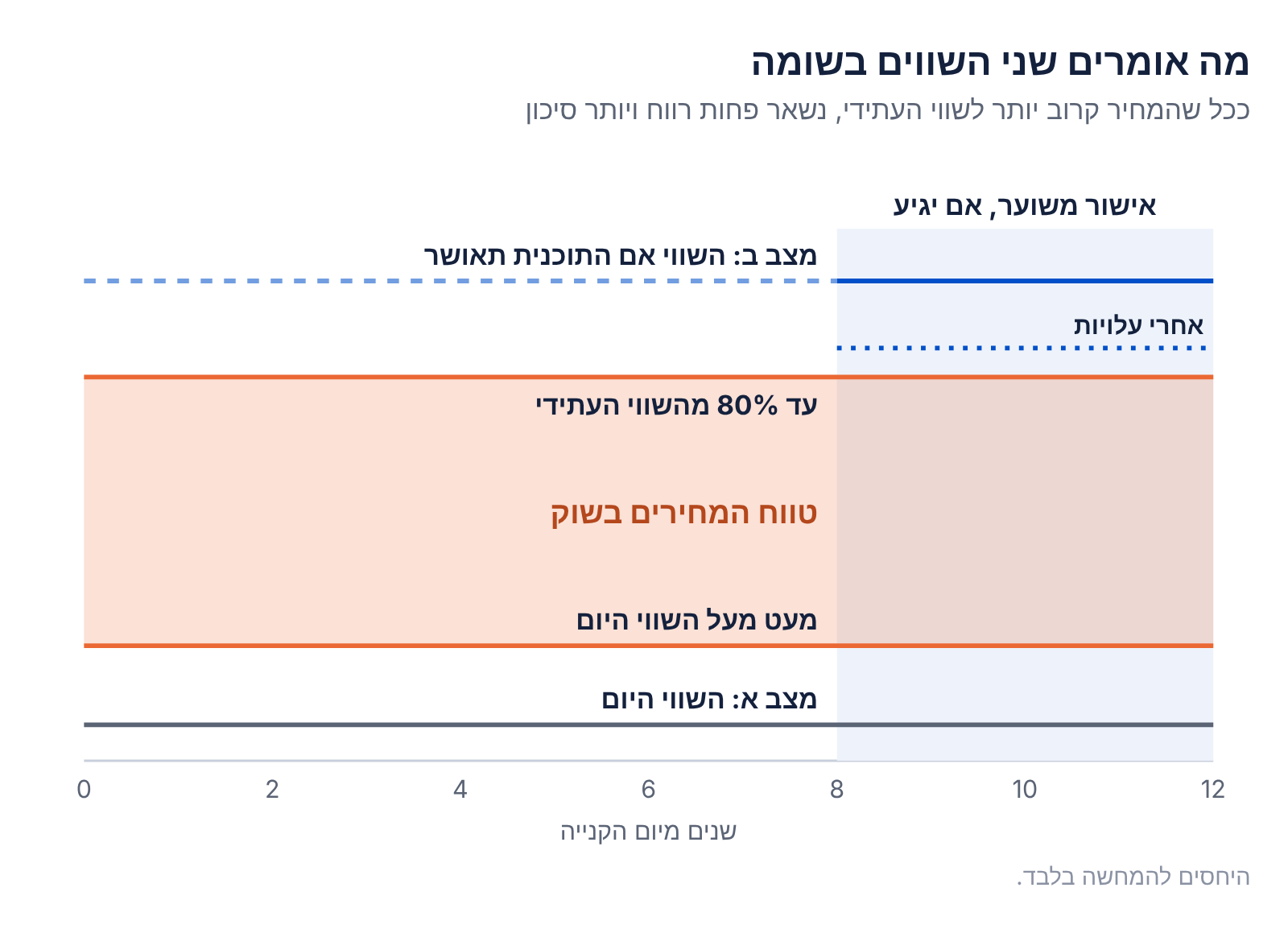
State A: the value today
What the land is worth in its current condition, based on approved plans only. For agricultural land, this is usually its value as agricultural land, with no expectation of construction.
State B: the value if the plan is approved
A theoretical value, as if the future plan were already approved and the land available for construction. This is an assumption, not a forecast that the plan will actually be approved.
In one sentenceThe price you pay is usually somewhere between State A and State B. The closer it is to State B, the more you are paying up front for a plan that has not yet been approved.
How to read the appraisal summary
The appraisal includes a short summary that brings together what matters to the buyer. These are its five parts, and what to check in each.
1. Current designationWhat may be built on the land now. For agricultural land, the answer is usually: not housing.
2. The two valuesState A and State B. Compare the price you are being asked to pay with both figures.
3. Likelihood of realizationWhat stage the planning is at: no plan, an outline plan, or a detailed plan in preparation. The appraiser may also write that the chance is slim.
4. Estimated timelineHow many years until the change of land designation, according to the appraiser's estimate. Money that waits for years is worth less than money today.
5. Realization costsBetterment levy (hetel hashbacha), development costs and taxes, and the buyer's share of them. These costs come off the profit in Scenario B.
On the stages land goes through before building on it is permitted: Land re-zoning: the 7 stages. On the costs: Betterment levy and Real-estate capital gains tax on land sales.
What to check yourself, beyond the appraisal
- 01The appraisal is up to date. The appraisal date is close to the transaction date, and it covers the block (gush) and parcel (helka) you are buying.
- 02The appraiser is licensed. The appraiser is listed in the Register of Real Estate Appraisers.
- 03The price vs. the two values. Check where the price falls between Scenario A and Scenario B.
- 04The plan really exists. Look up the block and parcel in ERRA Analytics and see which plans apply to them and at what status. Compare them with the plan in the appraisal, and verify in the Planning Administration's database.
- 05The price vs. transactions in the area. In ERRA Analytics you can see what parcels in the same block and the surrounding area sold for, and how prices have changed over time.
- 06Land Registry extract (nesach tabu). Check who the owners are, what the share is, and what is registered against it.
- 07Your own lawyer. A lawyer who represents you, not the seller, reads the agreement and the appraisal.
How to read an extract: Land Registry extract: how to read it. And what else to check before buying: The guide to buying land.
FAQ
Who pays for an appraisal standard 22 report?
When a dealer sells land that is not available for construction to a consumer, the dealer provides the appraisal free of charge. A buyer may also order an additional appraisal from an appraiser of their own, at their own expense.
How long before signing should I receive the appraisal?
A reasonable time in advance, and no less than 7 days before signing a binding document.
Does the Scenario B value guarantee a profit?
No. Scenario B is the value assuming the plan is approved. It does not say whether it will be approved, when, or to what extent.
Which land does the standard apply to?
Land that is not available for construction and is marketed to the public in the expectation that construction will be approved on it. This is usually agricultural land.
What if I didn't receive an appraisal?
Don't sign until you have received it. If you have already signed, consult a lawyer.
Summary
An appraisal standard 22 report is the buyer's tool for understanding what they are buying: land that is worth a certain amount today, and an expectation that, if a plan is approved, it will be worth more, in a few years and after costs. Read the two values, the timeline and the costs, and compare them with the price. The information in this article is general and does not constitute legal or appraisal advice.
Further reading and tools on the site
Articles
- Guide to buying land for investment
- Change of land designation: the 7 stages
- Land Registry extract: how to read it
- Betterment levy: who pays, when and how much
- Apartment or land: what to invest in
Tools and pages
- ERRA Analytics: all plans and transactions on every parcel
- Land profit calculator
- Our projects
- Properties for sale
Sources
- 01Ministry of Justice: The Real Estate Appraisers Council approved Standard 22
- 02Consumer Protection Regulations (Duty to Disclose Details in the Sale of Land Not Available for Construction), Regulation 3
- 03Walla Money: Appraisal Standard 22 takes effect
- 04Davidian Gideoni, Attorneys: Everything you need to know about Standard 22