- 2005
- The government approves TAMA 38
- About 160 thousand
- housing units received permits under it, over about 20 years
- 18.5.2026
- Final expiry
What Is TAMA 38
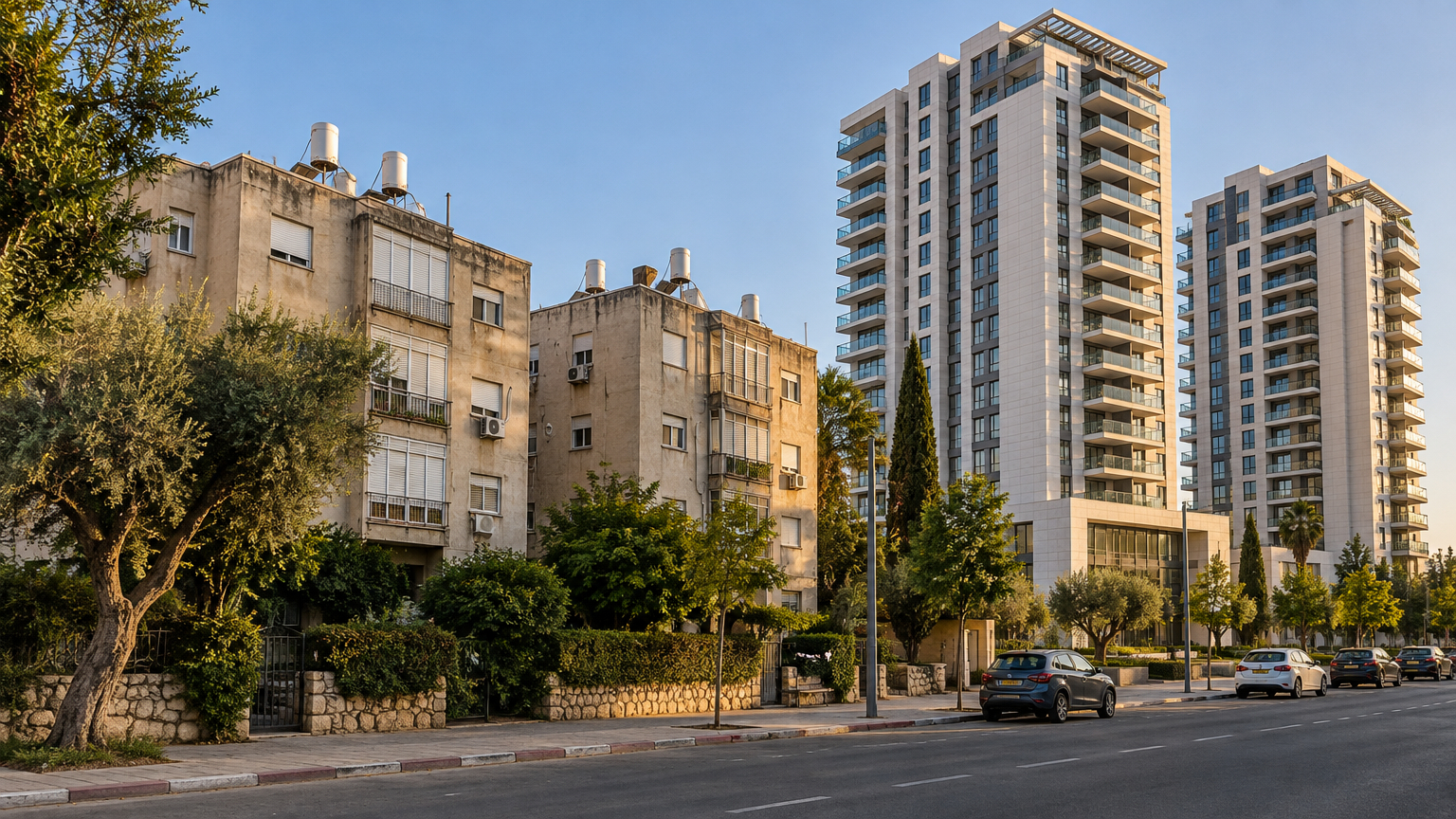
TAMA 38 is a National Outline Plan (Tochnit Mitar Artzit) that the government approved in 2005 to strengthen old buildings against earthquakes. Instead of the state funding the strengthening, the plan granted additional building rights. The developer sells the new apartments and uses the proceeds to fund the work.
It applies to buildings whose building permit was issued before 1980. Its great advantage was speed: a building permit, without waiting for a new plan. In this it differs from Pinui Binui (evacuation and reconstruction), which covers an entire compound and requires a new plan.
The Two Tracks
| Topic | TAMA 38/1: Strengthening and Addition | TAMA 38/2: Demolition and Rebuilding |
|---|---|---|
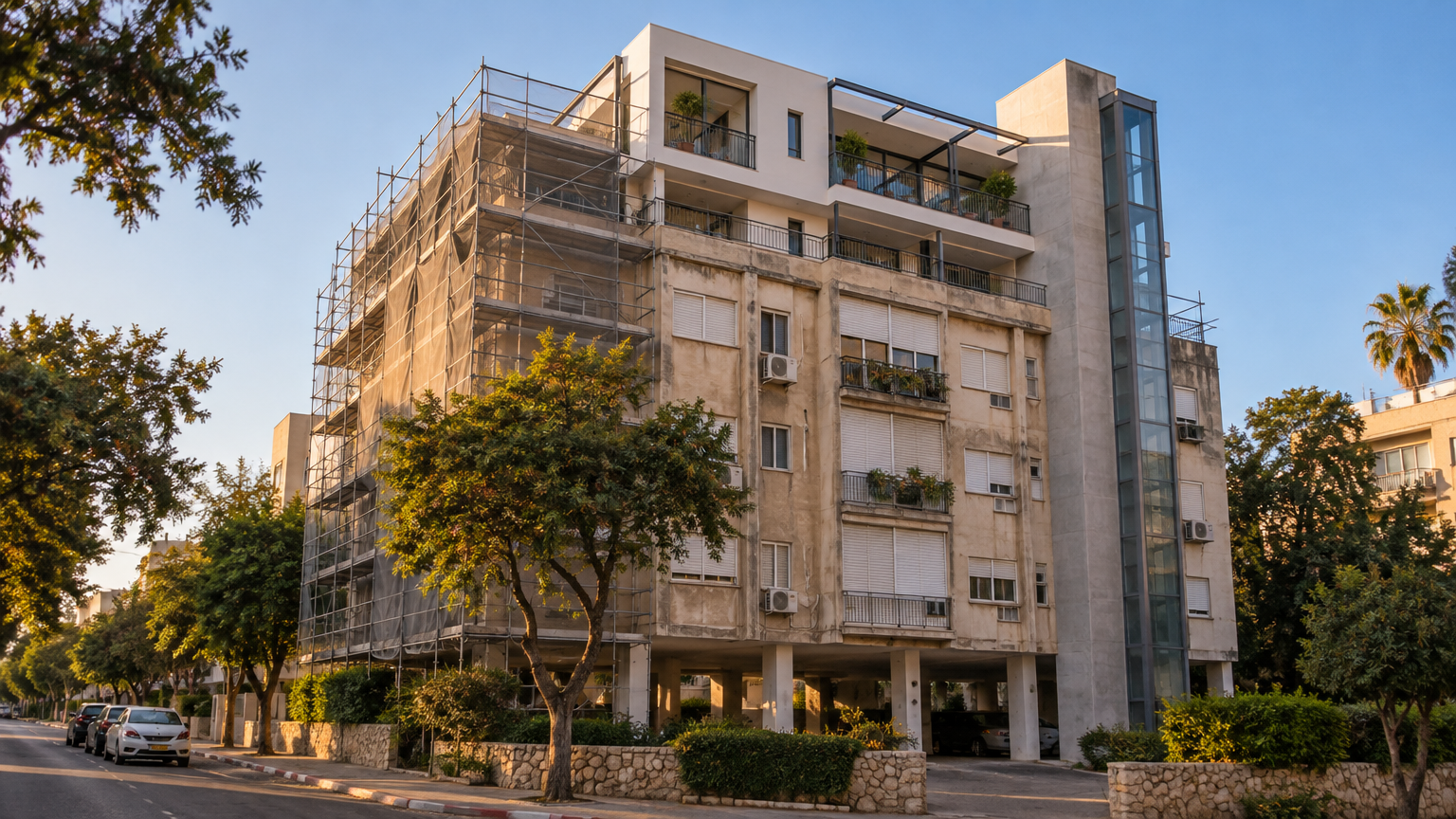
| What happens to the building | The building stays. It is strengthened and floors are added. | The building is demolished and a new one is built in its place. |
| What apartment owners receive | Usually an extension of up to about 25 m², including a safe room (mamad), plus an elevator and renovation. | A new apartment in a new building, with a safe room, and usually parking and an elevator. |
| Living at home during the work? | Yes, usually. | No. The developer pays rent until handover. |
| Required majority | Two-thirds of the apartment owners. | Two-thirds since 2023. Previously 80%. |
Why It Expired and When
The National Planning Council decided as early as 2019 to end TAMA 38. The main reason: projects were concentrated in the center of the country, where apartments are expensive, rather than in towns near the Syrian-African Rift, such as Tiberias, Safed and Kiryat Shmona, where strengthening is needed most. In Gush Dan it added thousands of apartments without any improvement to infrastructure and public institutions, and the exemption from betterment levy (hetel hashbacha) left local authorities without a source of funding for them.
The date was postponed several times. In the end it was determined that in cities that prepared a replacement plan, TAMA 38 would apply until that plan came into force or until May 2026, whichever came first.
- 2005Done
The government approves TAMA 38
Strengthening buildings against earthquakes in exchange for additional building rights.
What it meansA building permit for a single building, without a new plan.
- 2010Done
Demolition-and-rebuilding track
The second amendment to the plan added track 38/2: demolishing the building and building a new one.
- 2019Done
Decision to end the plan
The National Planning Council decided to end TAMA 38 and set transitional provisions.
What it meansCities were asked to prepare plans to replace it.
Source - May 2023Done
Two-thirds majority for demolition and rebuilding too
The Knesset Interior Committee lowered the required majority under TAMA 38/2 from 80% to two-thirds of the apartment owners.
What it meansThe amendment also applies to the plans that replace TAMA 38.
Source - 1.10.2023Done
Expiry in most cities
The plan expired, except in cities that received an extension because they had prepared a replacement plan.
Source - 18.5.2026Done
Final expiry
From this day on, new building permit applications can no longer be filed under TAMA 38, in any city.
What it meansWhat remains: permits already granted, and the plans each city prepares for itself.
SourceWe are here
What replaces it
There is no single nationwide track. Each city prepares its own plan, and today only under that plan can a single building be strengthened or demolished and rebuilt.
- Section 23 plan
- A detailed municipal plan that replaces TAMA 38 within the city's boundaries. It sets in advance how much can be built on each plot, and permits are issued under it. According to the Planning Administration, such plans are in force in Ramla, Yavne, Ra'anana, Hadera, Kfar Saba, Petah Tikva, Be'er Sheva and Givatayim.
- Comprehensive urban renewal plan
- A citywide plan approved by the District Planning Committee. After that, the Local Planning Committee can approve plans for individual plots according to its rules. Tel Aviv, for example, is advancing such a plan.
- Shaked Alternative (Amendment 139)
- A 2022 amendment to the Planning and Building Law that allows the Local Planning Committee to approve a plan to strengthen a building together with the permit. Such plans carry a betterment levy (hetel hashbacha) at a rate of 25%. According to the Real Estate Center, as of May 2026 not a single permit had yet been issued under it.
And what about protection?
After the wars of recent years, the need for safe rooms (mamad) in old buildings has grown. The expiry of TAMA 38 sharply reduced the number of new applications: according to the Real Estate Center, in 2025 the number of applications for building renewal permits fell by about 60%. In cities without a replacement plan, a single building that wants a safe room now needs a different track, such as a site-specific plan or evacuation-and-reconstruction (pinui binui).
Buying an apartment in an old building? What to check
- 01Does the city have a plan that replaces TAMA 38? And if so, whether it is already in force, and what it allows on your street.
- 02Check the plot in ERRA Analytics. Search for the block (gush) and parcel (helka), and see which plans apply to the plot, their status, and the transactions in similar buildings nearby.
- 03Does the building already have a permit? A permit granted under TAMA 38 before the expiry remains valid. A promise without a permit is only a promise.
- 04How many apartment owners have signed. And on what. Two-thirds of the apartment owners are required.
- 05What the building gets. A safe room, an elevator, parking, and with demolition and rebuilding, a new apartment as well.
- 06Who the developer is, and what guarantees they provide. Bank project financing, a Sale Law guarantee, a rent guarantee.
In one sentenceAfter May 2026, what determines whether an old building gets renewed is the municipality's plan, not TAMA 38.
FAQ
Is TAMA 38 still in force?
No. It expired for good on May 18, 2026, and new permit applications can no longer be filed under it. Permits already granted remain valid.
What is the difference between TAMA 38/1 and TAMA 38/2?
Under 38/1, the existing building is strengthened and floors are added to it. Under 38/2, the building is demolished and a new one is built in its place.
What replaces TAMA 38?
Plans prepared by each city: a Section 23 plan, a comprehensive urban renewal plan, or a plan under Amendment 139, also known as the Shaked Alternative.
How many apartment owners need to agree?
Two-thirds of the apartment owners, for both strengthening and demolition and rebuilding, since the 2023 amendment.
What is the difference between TAMA 38 and evacuation-and-reconstruction?
TAMA 38 dealt with a single building, under a permit. Evacuation-and-reconstruction (pinui binui) deals with a complex of several buildings and requires a new plan.
Summary
The TAMA 38 national plan strengthened and rebuilt tens of thousands of apartments, but it expired for good in May 2026. Today, the renewal of a single building depends on the municipality's plan, so the first step is to check whether such a plan exists, what it allows, and whether the building already has a permit. The information in this article is general and does not constitute legal advice.
Further reading and tools on the site
Articles
- Evacuation and reconstruction (pinui binui): how it works and how long it takes
- Betterment levy
- How to check land and plans yourself
- Apartment or land: what to invest in
Tools and pages
- ERRA Analytics: all plans and transactions on every parcel
- Land profit calculator
- Our projects
- Properties for sale
Sources
- 01Real Estate Center: TAMA 38 has expired for good, and most cities have no replacement for it
- 02Planning Administration: TAMA 38, Section 23 plans and comprehensive urban renewal plans
- 03Calcalist: The consent threshold for TAMA 38 has dropped to two-thirds
- 04ice: The majority required for demolition and reconstruction dropped from 80% to 67% (Section 5A of the Land Law)
- 05Kol Zchut: TAMA 38
- 06Globes: Residents' rights in reinforcement and in demolition and reconstruction
- 07ice: The new plans allow for a betterment levy (hetel hashbacha) and public spaces
- 08Real Estate Center: A drop of about 60% in applications for single-building renewal permits
- 09Calcalist: Why the Planning Administration wanted to end TAMA 38
- 10Knesset Research and Information Center: Reinforcing and Protecting Buildings (2021)
- 11Knesset Research and Information Center: Background on TAMA 38