- 15.7
- million residents expected in 2050
- 1.83
- million additional homes needed by 2050
- 65.5
- thousand homes a year needed from 2026
Two Plans, Two Questions
When people talk about "the strategic plan," they usually mean one of two documents. One answers the question of how many homes are needed, and the other the question of how and where the country will develop.
- Strategic Housing Plan 2050
- By the National Economic Council, March 2025. A forecast of the number of homes needed by 2050, by district and by population group. It updates the plan for 2040, which the government adopted in 2017.
- Strategic Spatial Plan
- By the Planning Administration, which published its main points in 2024. It deals with how the country will develop spatially: where construction is directed, how open spaces are preserved, and how the North and South are strengthened.
Where It Started: The Plan for 2040
In March 2017 the government adopted the Strategic Housing Plan for 2040. Under it, about 1.5 million new homes are needed by 2040, and therefore a stock of 2.6 million homes must be planned, because not every plan gets built on time. The number of households was expected to grow from 2.3 million to 3.8 million.
The central problem was identified even then: according to the team, open spaces allow for only about 960 thousand homes to be built. It was therefore determined that the share of new homes planned through urban renewal must rise from 12% to 46% by 2040. About this track: Pinui Binui (Demolition and Reconstruction).
How Many Homes Are Needed Each Year
According to the plan for 2050, the housing stock needs to grow by 62%: from about 2.96 million homes in mid-2024 to about 4.79 million in 2050. The target was set so that the ratio between the adult population and the number of homes returns to a level similar to that of 2005.
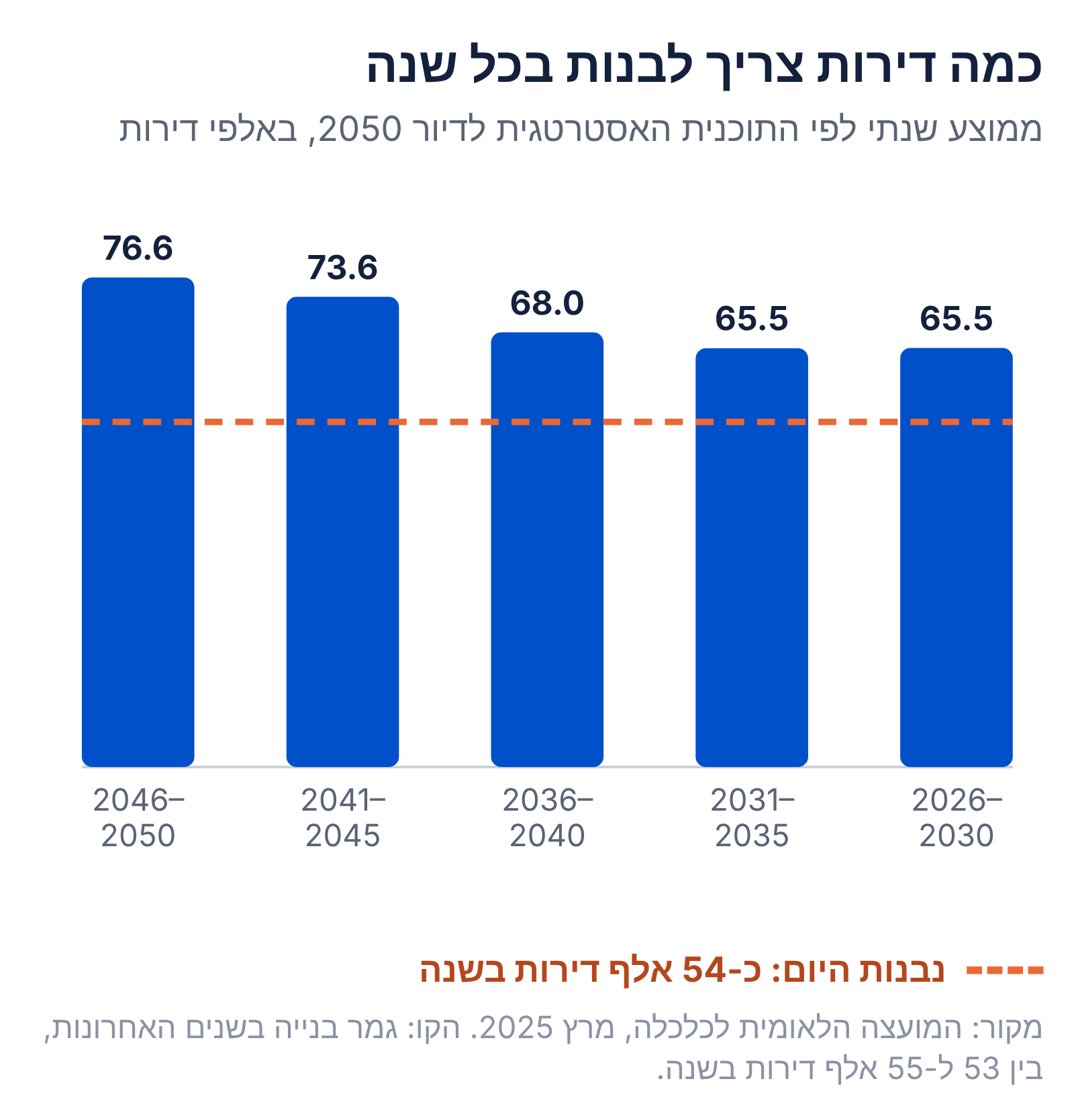
The gap is what matters: from 2026 about 65.5 thousand homes a year are needed, while in recent years construction has been completed on 54 to 55 thousand. After 2035 the need rises further, up to about 76.6 thousand homes a year by the end of the period. Every year in which less is built than the target adds to the shortage.
Where Development Is Heading
The plan for 2050 includes a separate forecast for each district. The Central District and the Tel Aviv District together are expected to receive about 585 thousand homes between 2025 and 2050, about a third of the total addition.
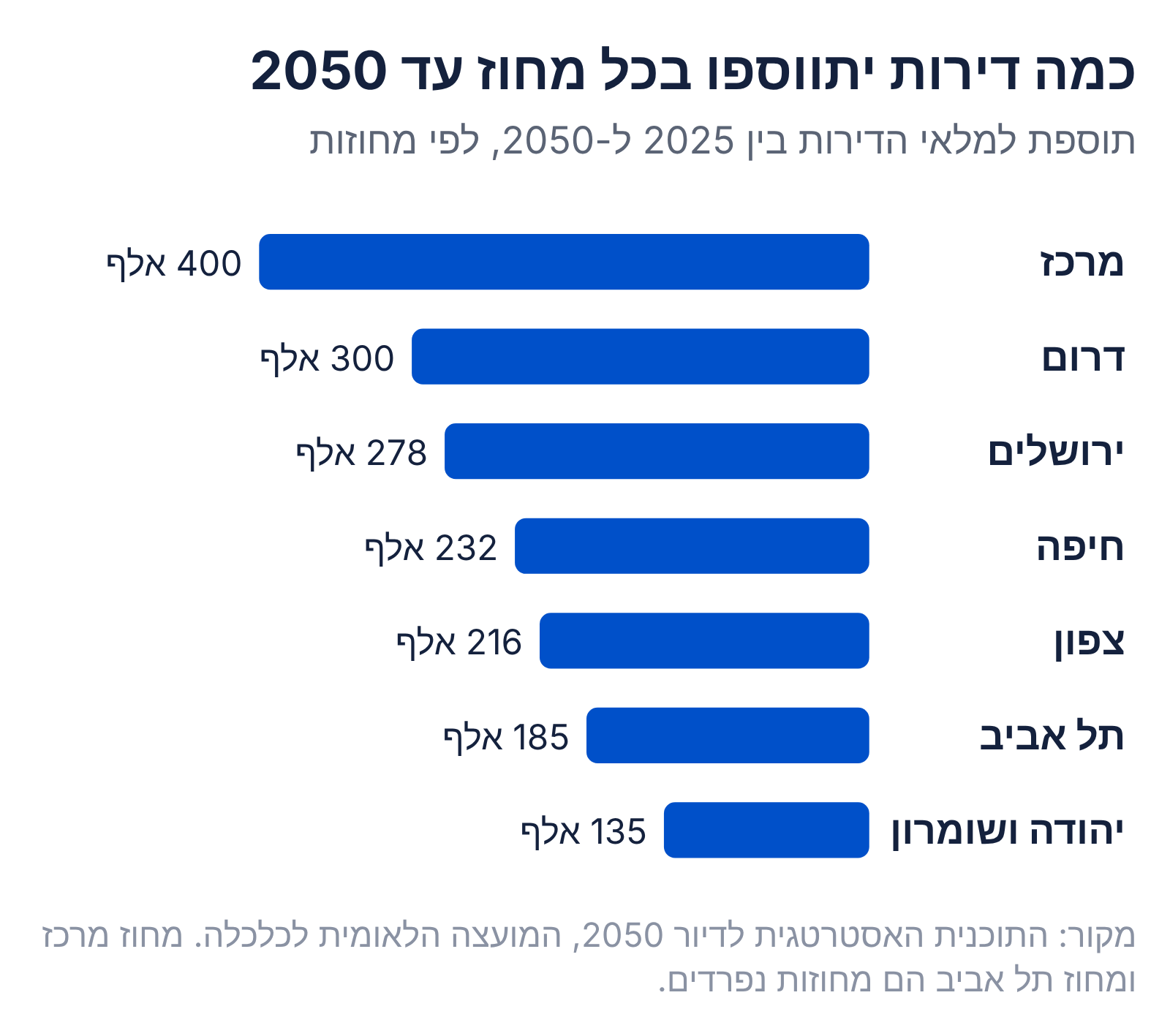
The South grows fastestThe population of the Southern District is expected to grow by about 88%, from about 1.42 million in 2022 to about 2.67 million in 2050. The forecast includes new Haredi cities in the Negev, among them Kasif.
JerusalemPopulation growth of about 79%, and about 278 thousand additional homes in the district.
Haifa BayNational Outline Plan TAMA 75 plans Haifa Bay as a residential and employment area, with about 105 thousand planned homes.
Center and Tel AvivThe most homes in absolute numbers, but a more moderate growth rate: about 54% in the Central District and about 37% in the Tel Aviv District.
Who the Homes Are Needed For
For the first time, the plan breaks down the need into three population groups. The need of the Haredi (ultra-Orthodox) public rises sharply, while that of the non-Haredi Jewish public declines slightly.
| Group | Homes per year, 2026 to 2030 | Homes per year, 2046 to 2050 |
|---|---|---|
| Non-Haredi Jews and others | about 35.6 thousand | about 30.4 thousand |
| Haredim (ultra-Orthodox) | about 13.5 thousand | about 29.2 thousand |
| Arabs | about 16.4 thousand | about 17 thousand |
How the landscape will change
The Planning Administration's spatial strategic plan directs most development to urban localities and the four metropolitan areas. It proposes dividing the country into 28 regions, each with services, employment and education within a relatively short drive. Its goals include strengthening the north and the south, doubling the population of the western Negev in the coming decades, building at higher density with more urban renewal, and preserving open spaces and ecological corridors.
What this means for land
DemandMore needs to be built than is being built today, so more land will be needed for construction. Where the population is growing fast, the pressure is greater.
Limited open spaceThe policy is to build densely, in and near cities, and to preserve open spaces. Land adjacent to an existing city therefore fits this policy better than isolated land. This is a trend, not a promise.
TimeGetting from a national forecast to a building permit involves several stages: a national outline plan, a district plan, a local outline plan and a detailed plan. Each stage can take years.
Forecasts changeThe plan for 2040 was updated in 2021, and the plan for 2050 is now replacing it. It, too, will be updated. Use it to understand the direction, not to set a price for a plot.
Checklist: how to use the forecast before buying land
- 01Which district the plot is in, and what the forecast is there. The plan for 2050 includes tables by district and sub-district.
- 02Check the parcel in ERRA Analytics. Look up the block and parcel (gush and helka), see which plans apply to it and their status, and compare with transactions in the area.
- 03What the current designation is. And is there a plan in preparation, deposited or approved that changes it?
- 04Which TAMA 35 fabric zone the parcel is in. Urban, rural or protected. In a protected zone, changing the designation is very difficult.
- 05How far it is from the existing city. And from roads, public transportation and infrastructure.
- 06Plan for the long term. Changing a designation takes years, not months.
FAQ
How many apartments does Israel need to build by 2050?
According to the National Economic Council's strategic housing plan, about 1.83 million additional apartments. Between 2026 and 2035, about 65 thousand apartments a year are needed, and more after that.
How many residents will Israel have in 2050?
The plan relies on the forecast of the Central Bureau of Statistics (CBS): about 15.7 million residents in 2050. According to an earlier CBS forecast, the population is expected to reach about 20 million by 2065.
Where will the most apartments be built?
In absolute numbers, in the Central District: about 400 thousand apartments between 2025 and 2050. In terms of pace, the Southern District is growing fastest.
Is Israel building enough apartments today?
No. In recent years, construction has been completed on 54 to 55 thousand apartments a year, while from 2026 about 65.5 thousand are needed.
Does the strategic plan change the designation of land?
No. It is a policy and forecasting document. Land designation and building rights are determined only in plans approved by the planning committees.
Summary
Israel needs about 1.83 million more apartments by 2050, and is currently building at less than the required pace. Development will be concentrated in cities and metropolitan areas, with particularly rapid growth in the south and in Jerusalem, and open spaces will be preserved as much as possible. The forecast helps you understand the overall direction, but the decision about a specific plot of land is made based on the plan that applies to it. The information in this article is general and does not constitute legal advice or investment advice.
Further reading and tools on the site
Articles
- Population density and real-estate prices
- Urban renewal (pinui binui)
- The Gush Dan Metro
- Change of land designation: the 7 stages from agricultural land to a building permit
- VATMAL: the fast track for planning neighborhoods
- How to check land and plans yourself
Tools and pages
Sources
- 01National Economic Council: The Strategic Housing Plan for 2050 (PDF)
- 02ice: Another 1.83 million housing units are needed by 2050
- 03Real Estate Center: Housing stock will grow by 62%, and the CBS forecast for 2050
- 04ice: The targets have changed, and construction completions stand at 54 to 55 thousand a year
- 05State Comptroller: The Strategic Housing Plan was adopted in March 2017
- 06Calcalist: The Housing Cabinet approved the plan for 2040
- 07Calcalist: Open spaces allow for only 960 thousand apartments
- 08Israel Hayom: 2.6 million apartments and 3.8 million households in 2040
- 09Maariv: The Strategic Spatial Plan and the 28 regions
- 10Planning Administration: Urbanism in the Strategic Spatial Plan 2050
- 11CBS: Israel population forecast to 2065