- 3
- rules in Section 122 of the Law: location, relative value and payment of differences
- Standard 15
- of the Real Estate Appraisers Council, for allocation tables
- 2
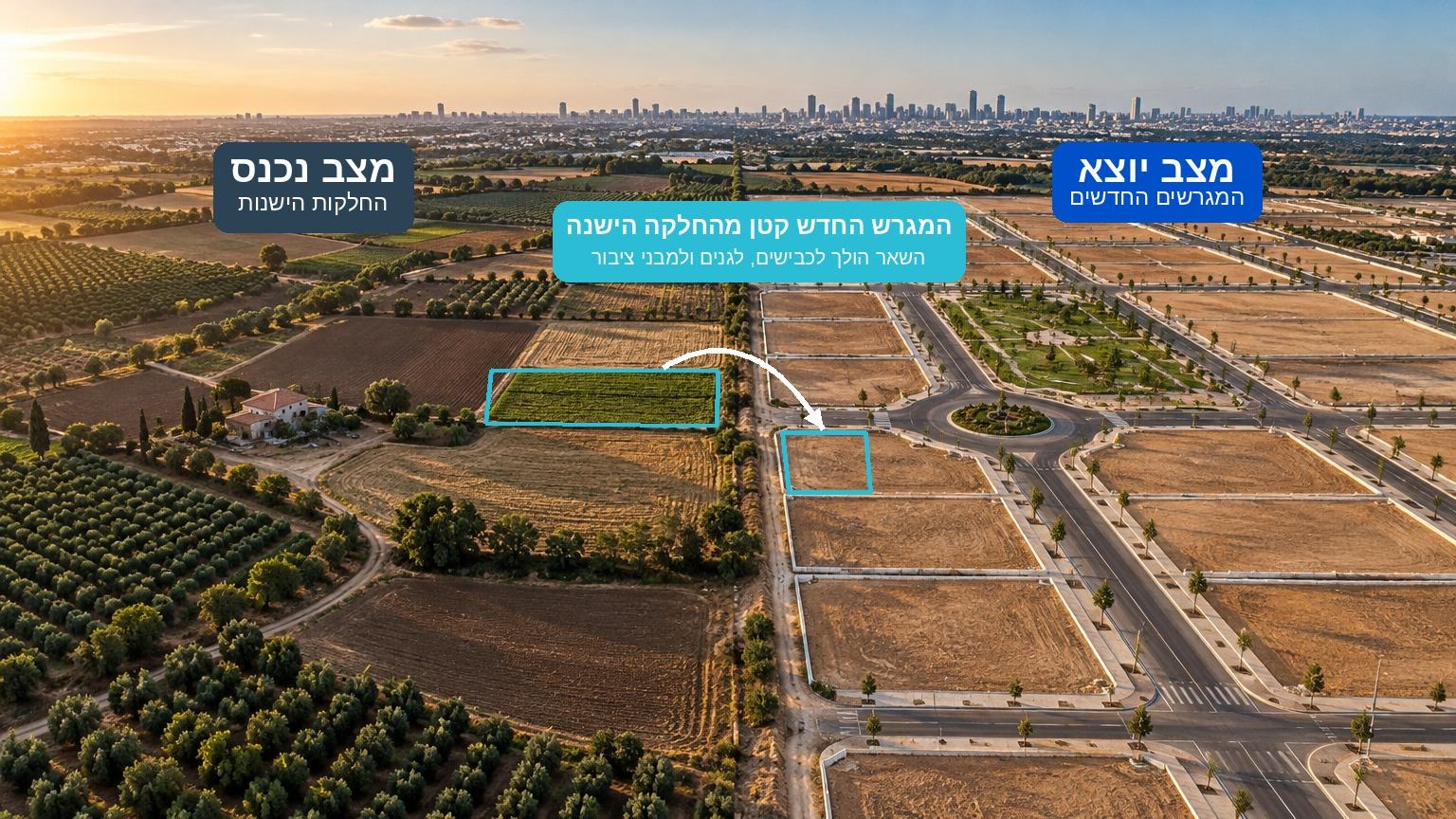
- states in every table: incoming state and outgoing state
Why a table is needed
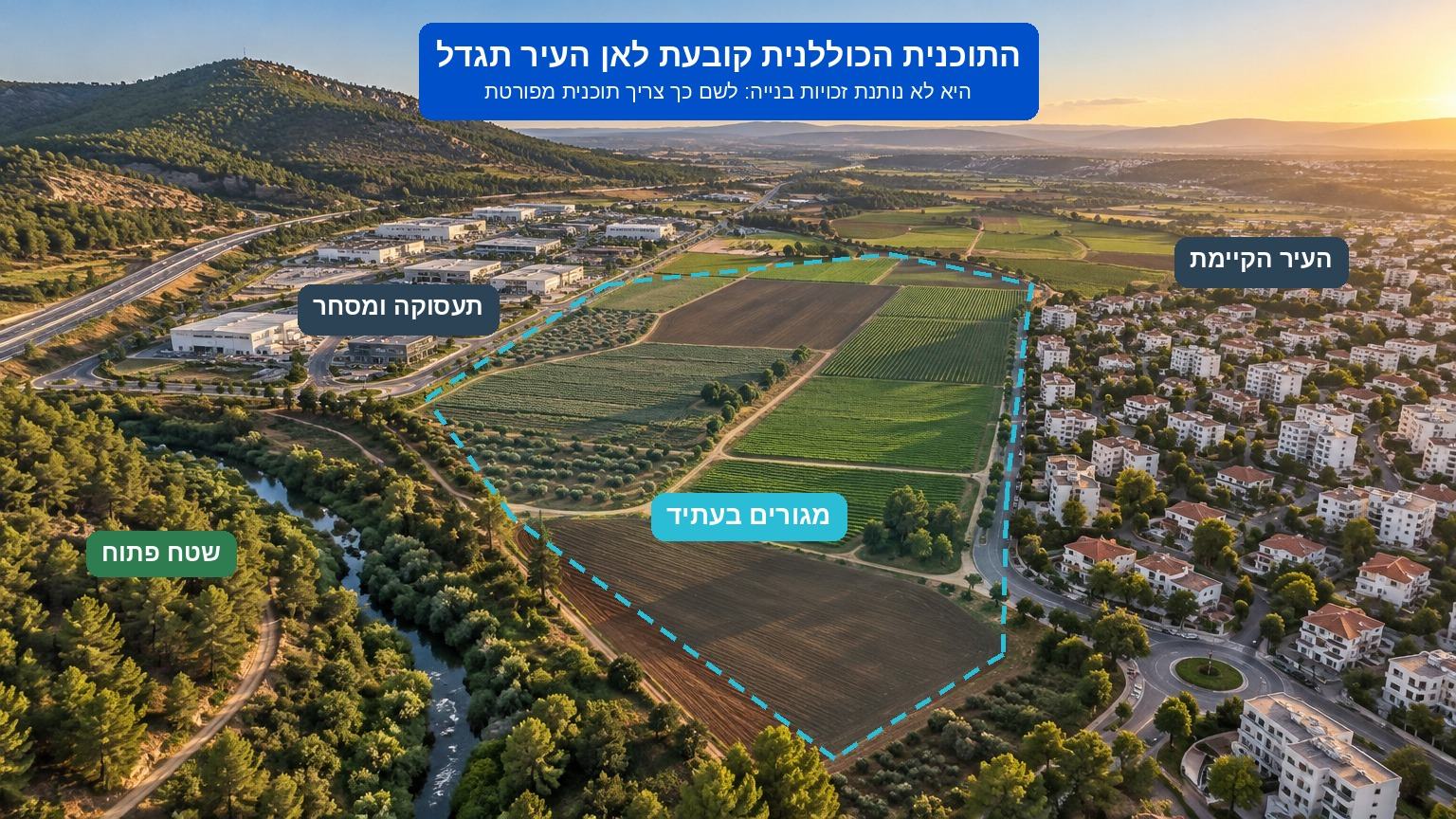
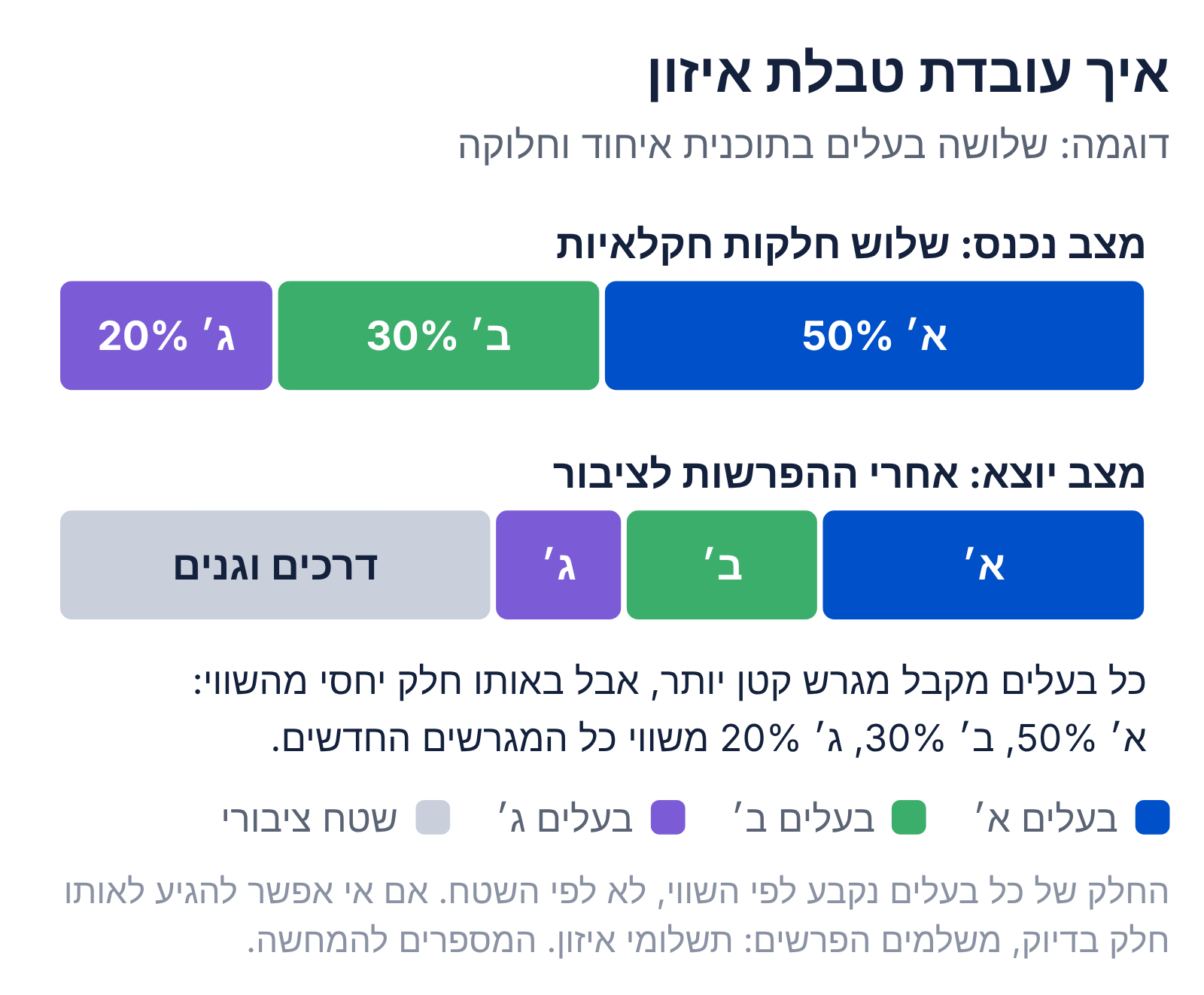
In a reparcellation plan, all the parcels in the plan area are merged, the areas for public use are deducted, and the land is redivided into building plots. Each owner's parcel no longer exists, and in its place they receive a new plot or a share in a plot. The table shows who gets what. On the areas for public use: expropriation for public purposes.
The three rules of Section 122
- Location
- The new plot will be as close as possible to where the previous parcel was.
- Relative value
- The share of the new plot out of all the new plots will be, as far as possible, the same as the share of the previous parcel out of all the previous parcels.
- Balancing payments
- If the same share cannot be reached, whoever received less is paid the difference by the local committee, and whoever received more pays the difference.
How to read the table
The table is published as an appendix to the plan, titled "Appendix of Allocation and Balancing Tables", and is prepared by a real-estate appraiser. It has two parts:
- Incoming state: each parcel before the plan. Block and parcel, area, the owners' names and each one's share, the designation, the value and the relative value in percent.
- Outgoing state: the new plots. Plot number, designation, area, building rights, the value and the relative value of each owner.
- Balancing payments: "will receive" and "will pay" columns for each owner.
The value is set using coefficients: a corner coefficient, shape, topography, a power line crossing the parcel, and more. Some tables also include a musha coefficient, meaning joint ownership. Some tables state explicitly that the values are intended for comparison between the owners and do not reflect market value.
When you hold a share in jointly owned land
Many investors in agricultural land hold a share in musha, meaning a share in a parcel without a marked location. A few points are especially important for them:
Musha coefficientAn appeals committee ruled that a reduction for joint ownership should be graded by the number of co-owners, and not uniform for everyone.
Registered co-ownership agreementAn internal division among the co-owners that was not registered or not duly approved is not taken into account. Register the co-ownership agreement at the Land Registry (Tabu) and notify the appraiser and the committee.
Shared plotCo-owners may receive shares in the same plot. Don't assume everyone will want to stay together: say in advance what you want.
Several parcels, same ownerUnder Standard 15, when an owner has several parcels, the allocation concentrates their rights, as far as possible, in a single plot.
On the co-ownership agreement and what it should include: Real-estate co-ownership agreement.
Checklist: checking the table
- 01Find the table. In the plan documents on the Planning Administration website, in the appendix of allocation and balancing tables.
- 02Check the parcel in ERRA Analytics. Look up the block and parcel (gush and helka), see which plans apply to it and their status, and compare with transactions in the area.
- 03Is the incoming state correct? Area, owners, shares and designation, exactly as in the Land Registry extract (nesach tabu).
- 04Are the coefficients reasonable? Corner, shape, topography, power line and musha (undivided joint ownership). Compare with the neighboring parcels.
- 05Where is the new plot? Close to the original location? With what designation and how many building rights?
- 06Are there balancing payments? How much you will receive or pay, and when.
- 07Consult an appraiser and a lawyer. And file an objection on time, when the plan is deposited for public review.
FAQ
What is an allocation and balancing table?
An appendix to a reparcellation (ihud vehaluka) plan that determines which new plot each owner receives, and whether anyone has to pay or receive differences.
Why is the new plot smaller than the parcel I had?
Because part of the area goes to roads, parks and public buildings. Your share is preserved by value, and the new plot is worth more because building on it is permitted.
What are balancing payments?
Monetary differences when it is not possible to give each owner exactly their proportional share. Whoever received less is paid, and whoever received more pays.
Who prepares the table?
A real-estate appraiser, in accordance with Section 122 of the Planning and Building Law and Standard 15 of the Real Estate Appraisers Council.
Can a table that has already been approved be changed?
It is very difficult. The court has ruled that it is a final proprietary act. That is why you review it when the plan is deposited for public review and file an objection on time.
Summary
An allocation and balancing table determines which plot each owner receives, based on the relative value of the land they had. Check the incoming (pre-plan) situation, the coefficients and the location of the new plot, and file an objection on time, because after approval it is almost impossible to make changes. The information in this article is general and is not legal advice or investment advice.
Further reading and tools on the site
Articles
- Expropriation for public purposes
- Reparcellation without the owners' consent
- Co-ownership agreement for real estate
- Appraisal standard 22: how to read a land appraisal
- Land Registry extract (nesach tabu)
Tools and pages
Sources
- 01Real Estate Center: tips for correct allocation in reparcellation plans, Section 122 (PDF)
- 02Real Estate Appraisers Council: clarification of Standard 15 (PDF)
- 03Wikisource: list of appraisal standards, Standard 15
- 04Sample table: corner, shape, topography, power line and musha coefficients (Planning Administration)
- 05Sample table: values for balancing purposes only (Planning Administration)
- 06Bizportal: Supreme Court, reparcellation with more than 40% for the public