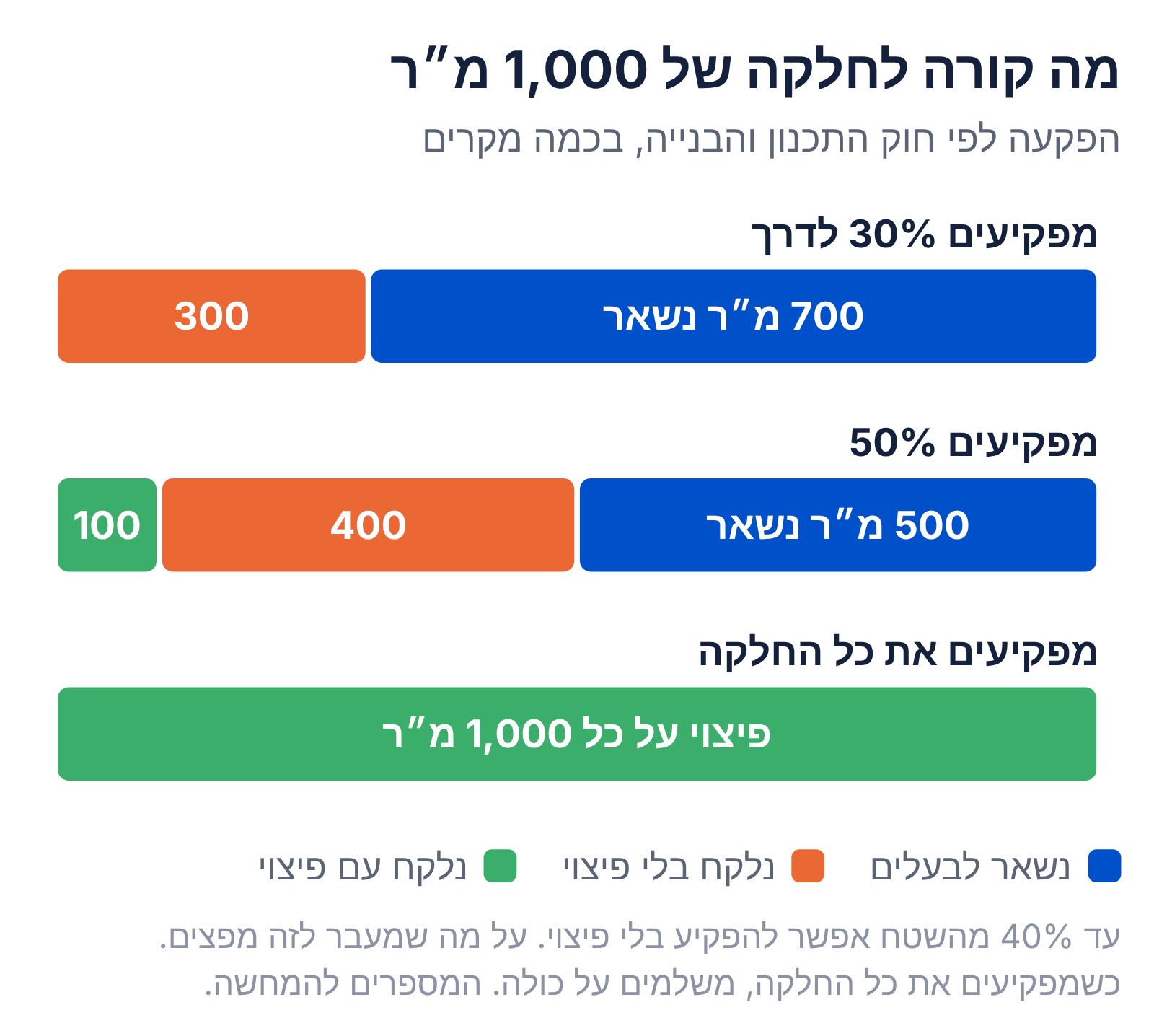
- 40%
- Can be expropriated without compensation under the Planning and Building Law
- 25%
- Without compensation under the Land Ordinance and the Roads Ordinance
- 100%
- Compensation when the entire parcel is expropriated
What is expropriation
Expropriation is the compulsory taking of private land for a public purpose. Several bodies are authorized to expropriate: the local planning and building committee, Netivei Israel, the Israel Electric Corporation, NTA and other authorities. Every expropriation must have a defined purpose.
The Planning and Building Law lists the public purposes for which land may be expropriated, such as roads, parks, educational buildings and public buildings. The idea behind expropriation without compensation is that the landowner benefits from the development: the road or the park increases the value of what they have left.
How much can be taken without compensation
- Planning and Building Law: up to 40%
- The local committee can expropriate up to 40% of the plot area for public purposes without paying. Expropriation above 40% is compensated.
- Land Ordinance and Roads Ordinance: up to 25%
- Expropriations under the Mandate-era ordinances allow up to 25% to be taken without compensation.
- The entire parcel is expropriated
- Under the Supreme Court's Holtzman ruling (halachat Holtzman), when an entire parcel is expropriated, the 40% or the 25% may not be deducted from the compensation. The owner is paid for all of it.
- Compensation for the "tolerable" portion
- In May 2018, an expanded five-justice panel of the Supreme Court ruled that even an owner from whom only a small part of the parcel was expropriated can receive compensation if what remains has not increased in value.
Two stages: change of designation, then expropriation
Expropriation usually comes in two stages. First, a plan changes the land's designation to a public one, such as a road or a public open space. For the loss of value at this stage, you can claim compensation under Section 197 of the Law. Later, when the authority actually expropriates the land, you receive compensation for the value of the land in its public designation, with the 40% deducted from it.
Expropriation on agricultural land undergoing a change of land designation
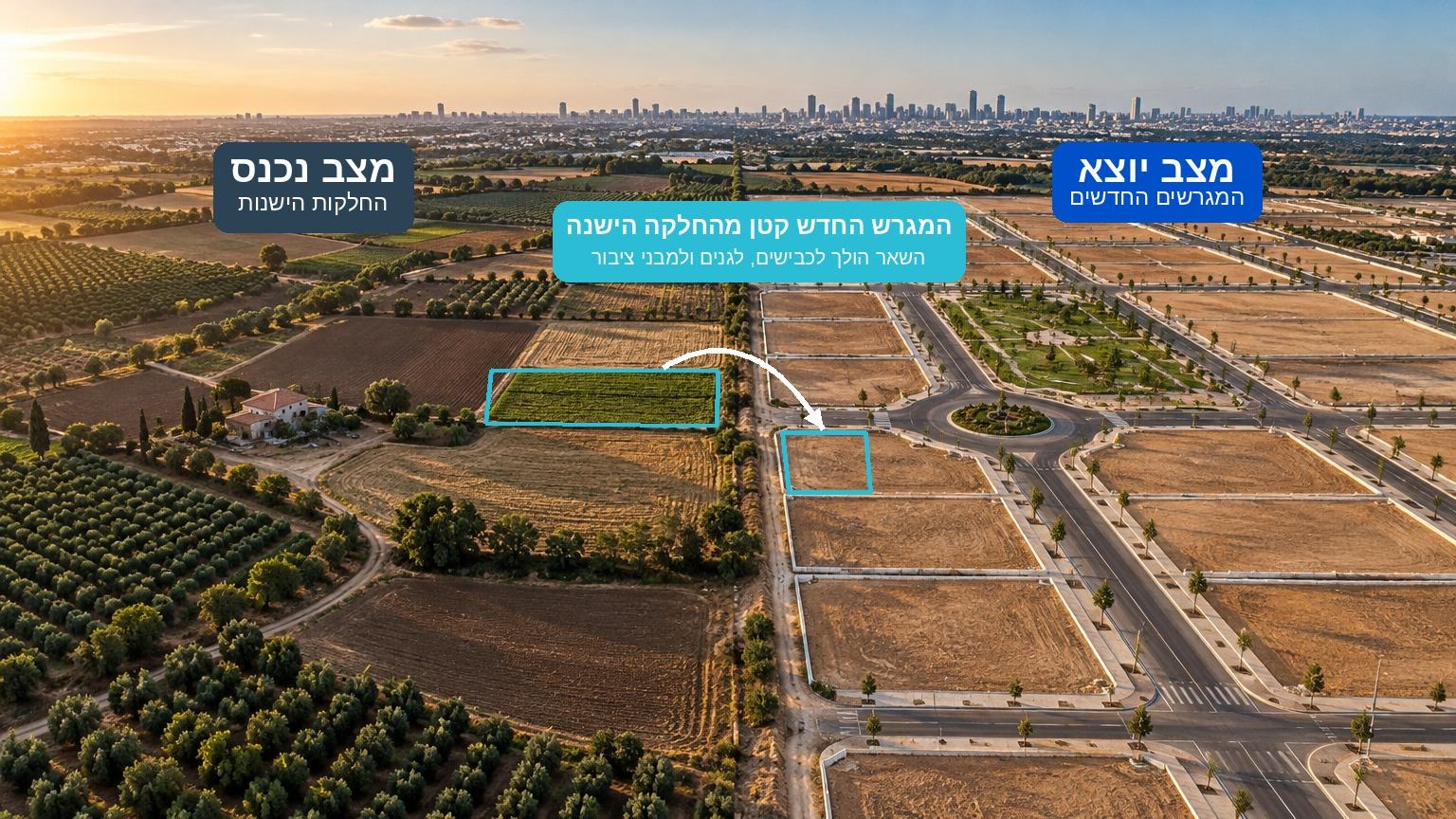
When agricultural land becomes a neighborhood, the areas for roads, parks and public buildings are set out in the plan itself, usually in a reparcellation plan. All the owners contribute a share, and each receives a plot in the new neighborhood according to the relative value of their land. That is why the plot you receive is smaller than the original parcel, but it is worth much more, because building on it is permitted.
The Supreme Court ruled that if more than 40% was taken for public use without compensation in a reparcellation plan, the plan is not void, but the owners are entitled to compensation. How the plots are divided: allocation and balancing table. And on the route without the owners' consent: reparcellation without consent.
Can an expropriation be canceled?
The courts do not cancel expropriations lightly. They examine how much time has passed, whether the public purpose still exists, whether the authority took steps to carry it out, and how much the owner was harmed. In 2019, the Supreme Court considered an expropriation in Tel Aviv from about 50 years earlier, for kindergartens that were never built. By a majority opinion, the expropriation remained in force, because in the meantime a real need had arisen and the municipality had begun building.
What it means for land buyers
The area you buy is not the area you build onOn land that has not yet been planned, part of the area will go to the public. Value is calculated according to the plot expected to be received, not the area of the parcel.
Land designated for public useA parcel marked for a road or a public area may be expropriated, and the compensation will be calculated according to its value in the public designation.
Expropriation can come years laterEven an old expropriation can be carried out. Check whether a notice of expropriation has already been published.
There is compensation, but not alwaysUp to 40% without compensation. It's worth checking with an appraiser and a lawyer whether you are entitled to compensation, rather than giving it up in advance.
Checklist: checking for expropriations before you buy
- 01Check the parcel in ERRA Analytics. Look up the block (gush) and parcel (helka), see which plans apply to it and at what status, and what designation each part of it has.
- 02Is part of it designated for public use? A road, public open space (shatzap) or land for public buildings (shabatz).
- 03Is there a reparcellation plan? If so, look at the balancing table: which plot is allocated, and at what value.
- 04Has an expropriation notice been published? Check the Official Gazette (Reshumot) and the local committee, and look at the Land Registry extract (nesach tabu).
- 05Calculate by the plot, not by the parcel. How many m² will remain after the public allocations.
- 06Get advice before you give up. An appraiser and a lawyer check whether you are entitled to compensation.
FAQ
How much of the land may be expropriated without compensation?
Under the Planning and Building Law, up to 40% of the plot area. Under the Lands Ordinance and the Roads Ordinance, up to 25%.
What do you get when the entire parcel is expropriated?
Compensation for the entire parcel, without a 40% or 25% deduction. This was established by the Supreme Court in the Holtzman ruling.
Who can expropriate land?
The local planning and building committee, Netivei Israel, the Israel Electric Corporation, NTA and other authorities empowered to do so.
Can an expropriation that was never carried out be canceled?
Sometimes. The court examines how much time has passed, whether the purpose still exists and whether the authority acted to carry it out. It does not happen easily.
Why is the plot you receive after a change of land designation smaller than the parcel?
Because part of the area goes to roads, parks and public buildings for the new neighborhood. In return, the plot is worth more, because building on it is permitted.
Summary
Under the Planning and Building Law, up to 40% of the land may be expropriated without compensation, and anything beyond that is compensated. When an entire parcel is expropriated, compensation is paid for all of it. On land undergoing a change of land designation, part of the area goes to the public, so the calculation is based on the plot expected to be received. The information in this article is general and does not constitute legal advice or investment advice.
Further reading and tools on the site
Articles
- Balancing and allocation table
- Reparcellation without the owners' consent
- Change of land designation: the 7 stages
- Betterment levy
- How to check land and plans yourself
Tools and pages
Sources
- 01Globes: Who is authorized to expropriate, 40% without compensation, and canceling an expropriation (2019)
- 02Globes: 25% under the ordinances, 40% under the Planning and Building Law, the Holtzman ruling
- 03Globes: The Holtzman ruling, no deduction when the entire parcel is expropriated
- 04Calcalist: Supreme Court, compensation for the "tolerance" portion even in partial expropriation (2018)
- 05Globes: Two stages, change of land designation and expropriation
- 06Bizportal: Supreme Court, reparcellation with more than 40% for the public
- 07Karka (KKL): Sections 188 and 190 of the Planning and Building Law