- 3
- Extract types: regular, historical and summary
- 5
- Extract sections to check before a transaction
- 18 ₪
- Approximately, per online extract
What is a Land Registry extract
“Tabu” is the common name for the Land Registry Office. The extract is an official document that shows what is recorded in the registers for a specific parcel: who the owners are, what mortgages and liens exist, and what restrictions apply. The information is correct as of the day the extract was issued, so a new extract is obtained close to signing.
Registration matters: under the Land Law, a transaction that has not been registered in the Tabu is only an undertaking to make a transaction. Ownership passes to the buyer when it is registered.
How to obtain an extract
- 1Find the block and parcel
The numbers appear in the contract, in the site plan or on the government maps. In a condominium building you also need the sub-parcel.
- 2Go to the government service
On gov.il, in the service “Issuing a Land Registry extract from the land registers.” Anyone can order an extract.
- 3Choose the extract type
For most transactions, a full regular extract is enough.
- 4Pay and download
By credit card. The extract arrives as a file.
- Full regular extract
- All the current information on the parcel. Suitable for most cases, such as buying and selling.
- Historical extract
- Also includes entries that have been deleted. Useful when you want to see the chain of ownership and previous transactions.
- Summary extract
- General information on all apartment owners in a condominium building, without all the registration details.
How to read an extract, section by section
In the fictitious example below, the five sections to check are marked. The structure is similar to a real extract, but the design is different.
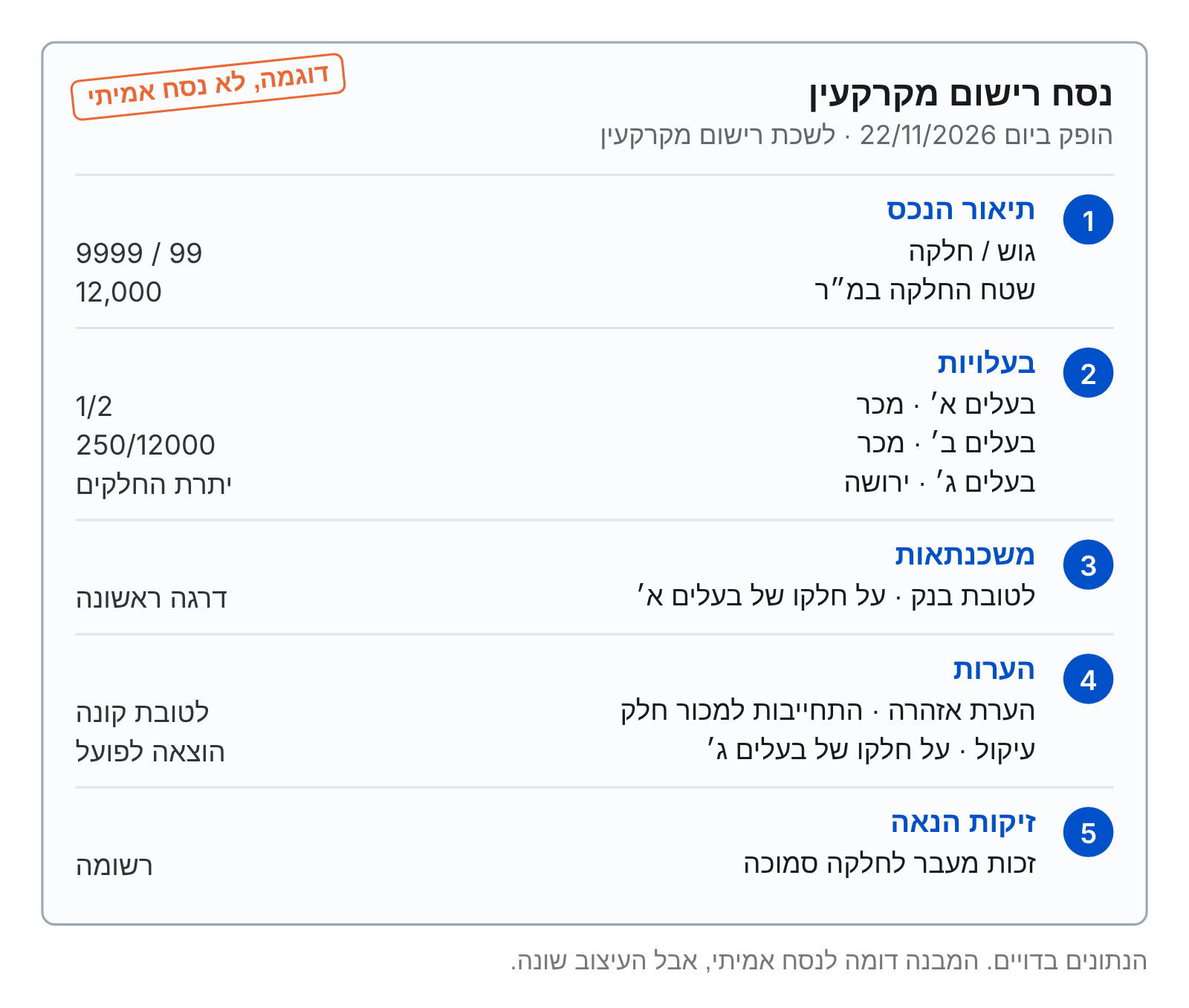
1. Property descriptionBlock, parcel and the registered area of the parcel. Check that the block and parcel match those in the contract and the site plan.
2. OwnershipWho the owners are, in what share, and how they acquired the right: sale, inheritance or gift. In jointly owned land, each owner appears with their share, for example 250/12000.
3. MortgagesA charge in favor of a bank or lender. In jointly owned land, the mortgage is usually registered on a specific owner's share, not on the whole parcel.
4. NotesWarning note, lien, court order. In land held in undivided co-ownership (musha), it is common to see warning notes in favor of many buyers, each on their own share. Check that there is no lien, and that there is no note in favor of another person on exactly the same share that was sold to you.
5. EasementsA right held by someone else to use the land for a specific purpose, such as access to a neighboring parcel. It can restrict what may be built on that part of the land.
How to read shares in jointly owned land
In land held in undivided co-ownership (musha), each share is recorded as a fraction. 250/12000 means 250 parts out of 12,000, that is, 250 m² if the parcel's area is 12,000 m². When the fraction is not stated in m², multiply it by the parcel's area to find out how many m² it represents.
In one sentenceThe fraction in the extract is a share of the entire parcel, not a marked plot. What you will actually receive is determined only in the plan, in the allocation table.
On the rights and obligations of co-owners of a single piece of land: Co-ownership agreement for real estate. And on what happens to your share in the plan: Reparcellation.
Warning note (he'arat azhara): what it is and why it is registered
A warning note informs everyone that the owner has committed to a transaction, for example to sell you their share. It prevents the owner from selling that same share to someone else without your consent. That is why buyers register a warning note immediately after signing, even before ownership is registered in their name.
Checklist: what to check in the extract before buying
- 01The extract is up to date. Issued within the last few days, and again close to signing.
- 02Check who the seller is in the extract. A registered owner, or the holder of a warning note who bought and paid, until ownership is registered in their name. The name and ID number match the contract.
- 03The share matches the contract. The fraction in the extract matches the area you are buying.
- 04Check the parcel in ERRA Analytics. Search for the block and parcel listed in the extract, and see on the map the boundaries, the plans that apply to the parcel and the transactions made in it.
- 05There is no attachment on your share. And there is no court order or note in favor of another person on that exact share. Notes in favor of other buyers in the parcel are normal in musha.
- 06A mortgage, if any, will be removed. The contract sets out how and when it will be paid off and deleted.
- 07Check for a registered co-ownership agreement. If there is one, read it before signing.
The extract shows only the legal side. The planning side, what may be built and what stage the plan is at, is checked separately: The land purchase guide and Change of land designation: the 7 stages.
FAQ
How much does a Land Registry extract cost?
An online extract on the government website costs about 18 ₪, as of 2026. Private websites charge more for the same service.
Who can obtain a Land Registry extract?
Anyone, for a fee. You do not need to be the owner or show any connection to the property.
What is the difference between a regular extract and a historical extract?
A regular extract shows the current status. A historical extract also shows entries that have been deleted, such as previous owners and mortgages that were paid off.
What is a warning note?
An entry at the Land Registry stating that the owner has committed to a transaction involving the property. It protects the buyer against a double sale of the same share.
What does a fraction such as 250/12000 in the extract mean?
A proportional share in a jointly owned parcel: 250 parts out of 12,000. In a parcel of 12,000 m², this equals 250 m², but without a marked location.
Summary
A Land Registry extract is the first check before any land transaction. Obtain an up-to-date extract on the government website, check the owners, the share, the mortgages and the notes, and register a warning note immediately after signing. The information in this article is general and does not constitute legal advice.
Further reading and tools on the site
Articles
- Guide to buying land for investment
- Co-ownership agreement for real estate
- Right to an apartment: what the term really means
- Change of land designation: the 7 stages
Tools and pages
- ERRA Analytics: all plans and transactions on every parcel
- Land profit calculator
- Our projects
- Properties for sale
Sources