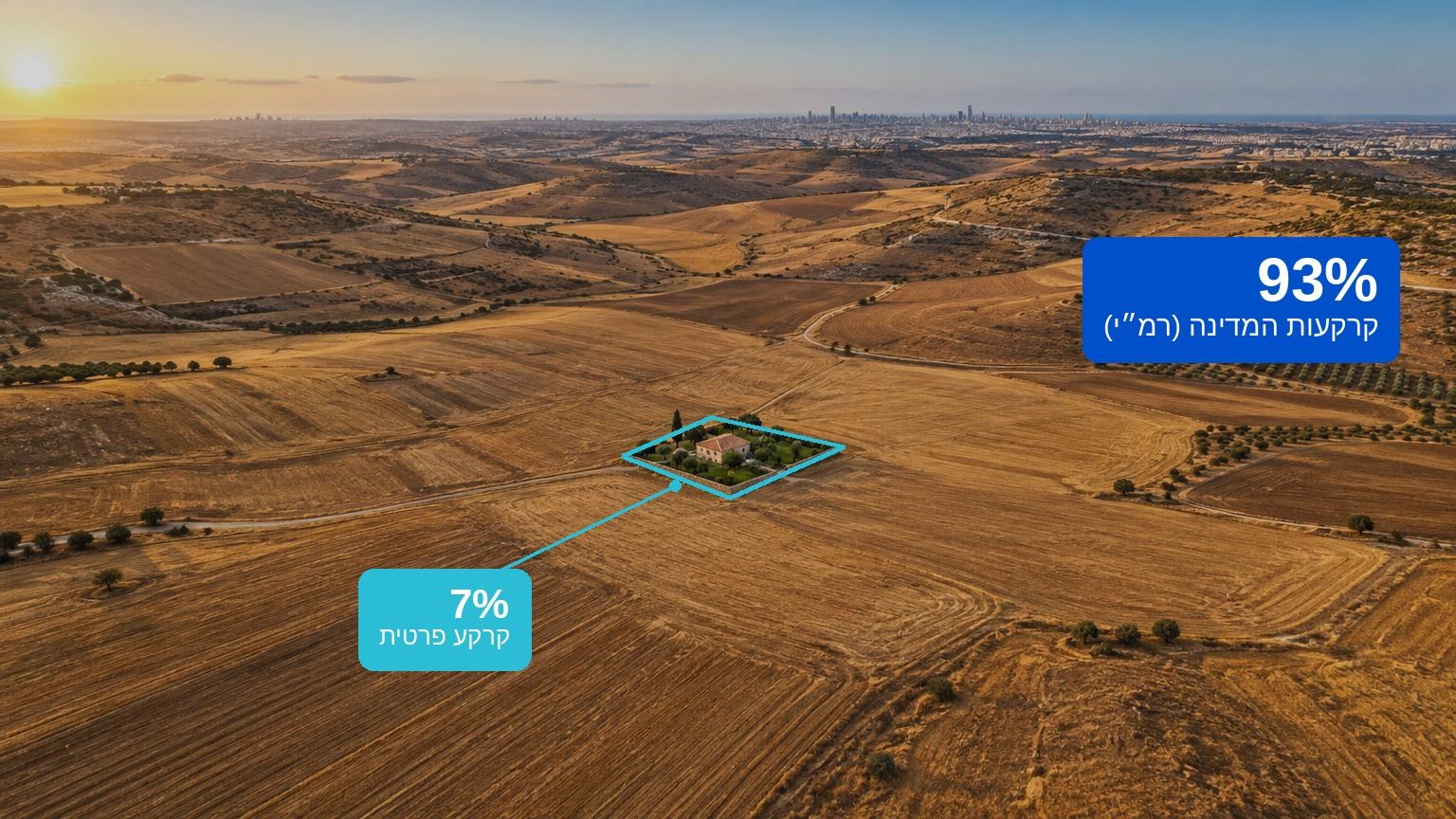
- 2
- Main types: percentage and net
- 0 ₪
- Cash to the landowner on signing day, usually
- 3
- Guarantees to check: Sale Law, taxes, defects
What is a combination deal
It is an exchange transaction. The landowner sells part of their rights in the land to the developer. In return, the developer undertakes to build apartments, or other units, for them on the part that remains in their ownership. The developer finances the planning and construction and sells its own apartments to buyers.
The deal suits land that already has a plan permitting construction, or is close to having one. On agricultural land without a plan, there is nothing to build yet. On the stages along the way: Re-zoning land, the 7 stages.
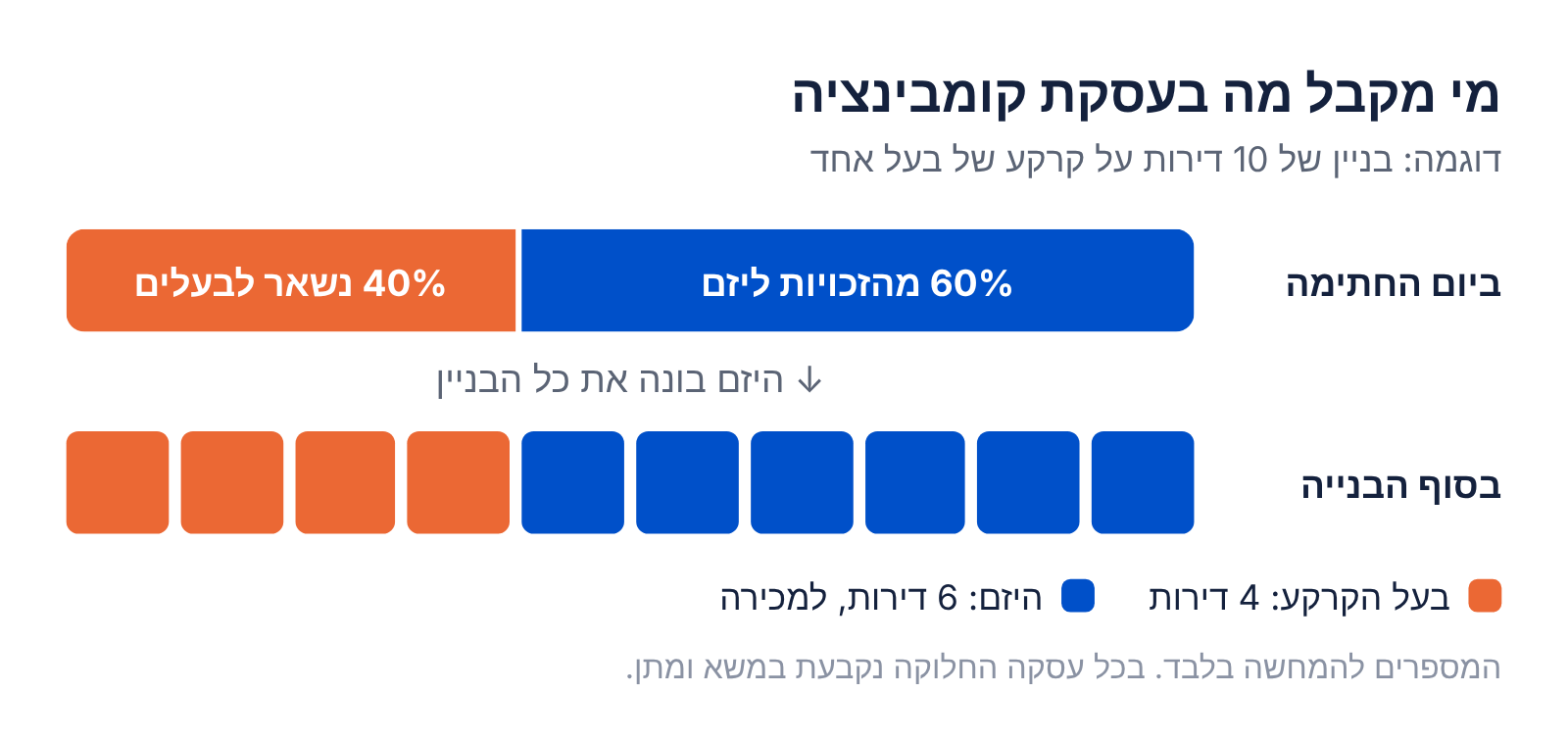
How the deal progresses
- 1Choose a developer
Compare several offers, as well as the developer's financial strength, experience and bank project financing.
- 2Sign an agreement
The split, the apartment specifications, the timelines and the securities are set. From the day of signing, the clock starts running on tax reporting.
- 3Plan and obtain a permit
The developer submits a plan or a building permit application, depending on what already exists for the land.
- 4Sign bank project financing and build
The bank finances the construction and safeguards the buyers' money.
- 5Receive the apartments and register
The landowner receives their apartments, and the building is registered as a condominium.
Percentage deal vs. net deal
| Topic | Percentage deal | Net deal |
|---|---|---|
| What the landowner receives | A proportional share of the project's built area | A defined number of apartments, with specifications |
| Who pays the taxes | Each party pays its own taxes | Usually the developer, including the landowner's taxes |
| If the project grows | The landowner gains along with it | The landowner does not receive more |
| Certainty | Less | More |
In one sentenceA higher percentage is not necessarily a better offer. Check what the percentage is of: which area, what specifications, which floor and what timeline.
Who pays which tax
For tax purposes, a combination deal is a sale of part of the land. The landowner pays real-estate capital gains tax (mas shevach) on the part they sold, and the developer pays purchase tax (mas rechisha) on the part they bought. The consideration is construction services rather than money, so the sale value is usually set according to the value of the construction services.
The date of sale for tax purposes is the day the agreement is signed, not the day you receive the apartments. The purchase date of the apartment the landowner receives is also the signing date. That is why the deal is reported to the Israel Tax Authority close to signing, even though the apartments will only arrive several years later. On calculating capital gains tax: Capital gains tax on the sale of land.
The landowner's risk, and how to reduce it
The landowner hands over the rights on the signing date and receives the consideration only at the end. If the developer gets stuck or collapses midway, the landowner may be left with excavated land, a warning note (he'arat azhara) in the developer's favor and no apartments. That is why the agreement must include:
- 01A bank guarantee against the warning note. The developer receives a warning note on the land only when they deposit a bank guarantee of appropriate value.
- 02A guarantee for the landowner's apartments. A guarantee under the Sale Law or other security that protects the apartments they are due to receive.
- 03A tax guarantee. Where the developer has undertaken to pay taxes, a guarantee that ensures they will pay them.
- 04A warranty guarantee. For repairing defects after the apartments are handed over.
- 05Milestones with deadlines. Plan submission, permit, construction financing agreement and start of construction. Every missed deadline has a consequence: a right to exit, deletion of the warning note and return of the power of attorney.
- 06A binding specification. Apartment size, floor, parking spaces and storage rooms, as an appendix to the agreement.
A combination deal on land with several owners
When the land is held in undivided co-ownership (musha), the developer usually needs the signatures of most of the owners, and sometimes of all of them. An owner who holds a small share receives a small apartment or a share in an apartment, or a payment instead. A good co-ownership agreement sets out in advance how a deal like this is decided: Co-ownership agreement for real estate. And if the land goes through reparcellation, your share will be set in the allocation table: Reparcellation.
- Combination deal
- You sell the developer part of the land, and receive apartments that they build on the remaining part.
- Proceeds-sharing deal
- You sell the developer all of the land, and receive part of the money they will receive from selling the apartments.
- Cash sale
- You receive the full consideration in money, without waiting for construction and without developer risk. Usually at a lower price.
FAQ
Does the landowner receive money on the signing date?
Usually not. The consideration is the apartments the developer builds, and they arrive at the end of construction. Sometimes a cash payment is added as well, and this is set in the agreement.
Who pays capital gains tax in a combination deal?
The landowner, on the part they sold to the developer. In a net deal, the developer usually undertakes to pay the tax on their behalf.
When is the deal reported to the Israel Tax Authority?
Close to the signing date. That is the date of sale for tax purposes, even if the apartments will only be handed over several years later.
What happens if the developer does not meet the timelines?
It depends on the agreement. A good agreement sets a deadline for each stage and what happens if it passes: a right to cancel, deletion of the warning note and return of the power of attorney.
What is the difference between a combination deal and TAMA 38?
TAMA 38 is a type of combination deal on an existing building, and it has tax benefits of its own. A regular combination deal, for example on a plot, does not receive these benefits.
Summary
A combination deal allows a landowner to receive apartments without financing construction, but the consideration arrives only at the end. Compare offers by what you actually receive rather than by the percentage, report to the tax authority close to signing, and demand guarantees and milestones with a right to exit. The information in this article is general and is not legal or tax advice.
Further reading and tools on the site
Articles
- Change of land designation: the 7 stages
- Capital gains tax on the sale of land
- Betterment levy: who pays, when and how much
- Co-ownership agreement for real estate
- Right to an apartment: what the term really means
Tools and pages
- ERRA Analytics: all plans and transactions on every parcel
- Land profit calculator
- Our projects
- Properties for sale
Sources
- 01Real Estate Center: Taxation of combination deals and TAMA 38
- 02Real Estate Center: Time and Risk in Calculating the Sale Value in Combination and Consideration Transactions
- 03Calcalist: Value of the right sold is based on the value of the construction services, Appeals Committee
- 04CA 8789/02 Director of Real Estate Capital Gains Tax (mas shevach), Haifa v. Shadmi
- 05Calcalist: 45% of What? The Percentage That Misleads Landowners in Combination Deals