- 126
- The section of the Land Law under which the note is registered
- 127
- The section that sets out what the note blocks
- 132
- The section that sets out how it is removed
What is a warning note
A warning note is an entry in the Land Registry (Tabu) that notifies everyone that the owner has committed in writing to carry out a transaction in the land, for example to sell you their share, or has committed not to carry out a transaction in it. It is registered under section 126 of the Land Law and appears in the notes section of the Land Registry extract.
The note does not transfer ownership to you. Ownership passes only when the transaction itself is registered in the Land Registry. Until then, the note holds your place. How to read this section of the extract: The Land Registry extract, section by section.
What it protects against
Double saleAs long as the note is registered, no transaction that contradicts it will be registered, except with your consent or under a court order. If the owner sells the same share to someone else, the second buyer will not be able to register it in their name.
Later attachmentAn attachment registered after the note, because of a debt of the seller, does not harm your right.
Seller's collapseEven if the seller goes bankrupt or into liquidation, the note gives you priority over the seller's other creditors.
Does not expire over timeA registered note is not subject to a statute of limitations. It remains until it is removed.
How to register a warning note
- 1Sign a written contract
The note is registered on the basis of a written commitment by whoever is registered in the Land Registry as the owner, or as the holder of another right in the land.
- 2Fill out a registration application
On the Land Registrar's form. A lawyer certifies the signatures.
- 3Pay the fee and attach an extract
A registration fee according to the Ministry of Justice rate, and an up-to-date extract for the parcel.
- 4Submit
A lawyer can submit online. You can also submit at the Land Registry office, by appointment.
- 5Get a new extract
And check that the note was registered in your favor, on the correct share.
In one sentenceThe note is registered right after signing, and the money is held in trust by a lawyer until it is registered.
Warning notes on land held in musha
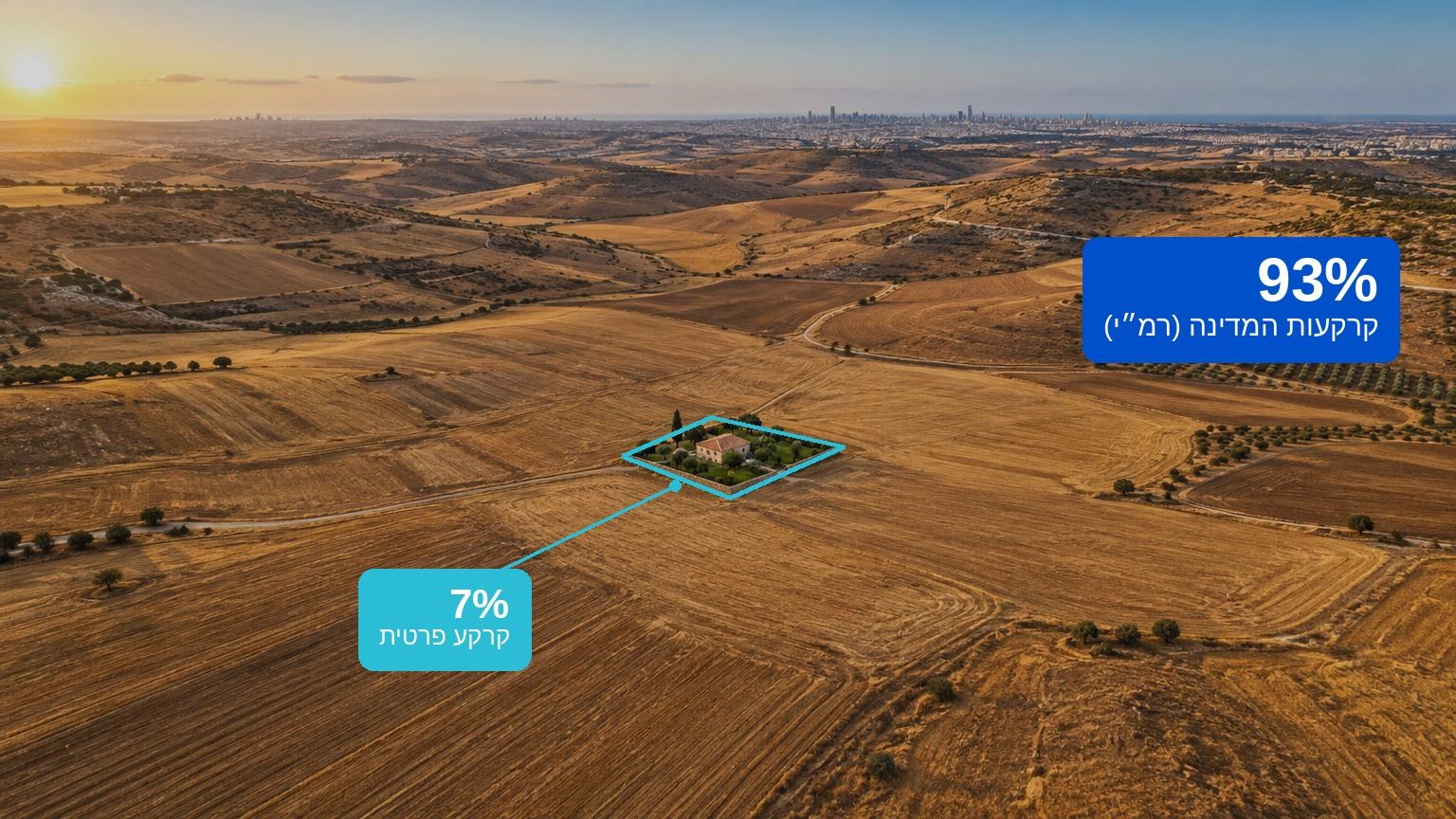
With land held in undivided co-ownership (musha), you buy a proportional share of the parcel, with no marked-out plot. The note is registered on the seller's share and states which part of the parcel the seller committed to transfer to you. A single parcel can carry many notes, in favor of many buyers.
That's why it isn't enough to see that a note exists. You check in whose favor it is, on whose rights, and for how much. On the relationship between the co-owners of a parcel: Land co-ownership agreement.
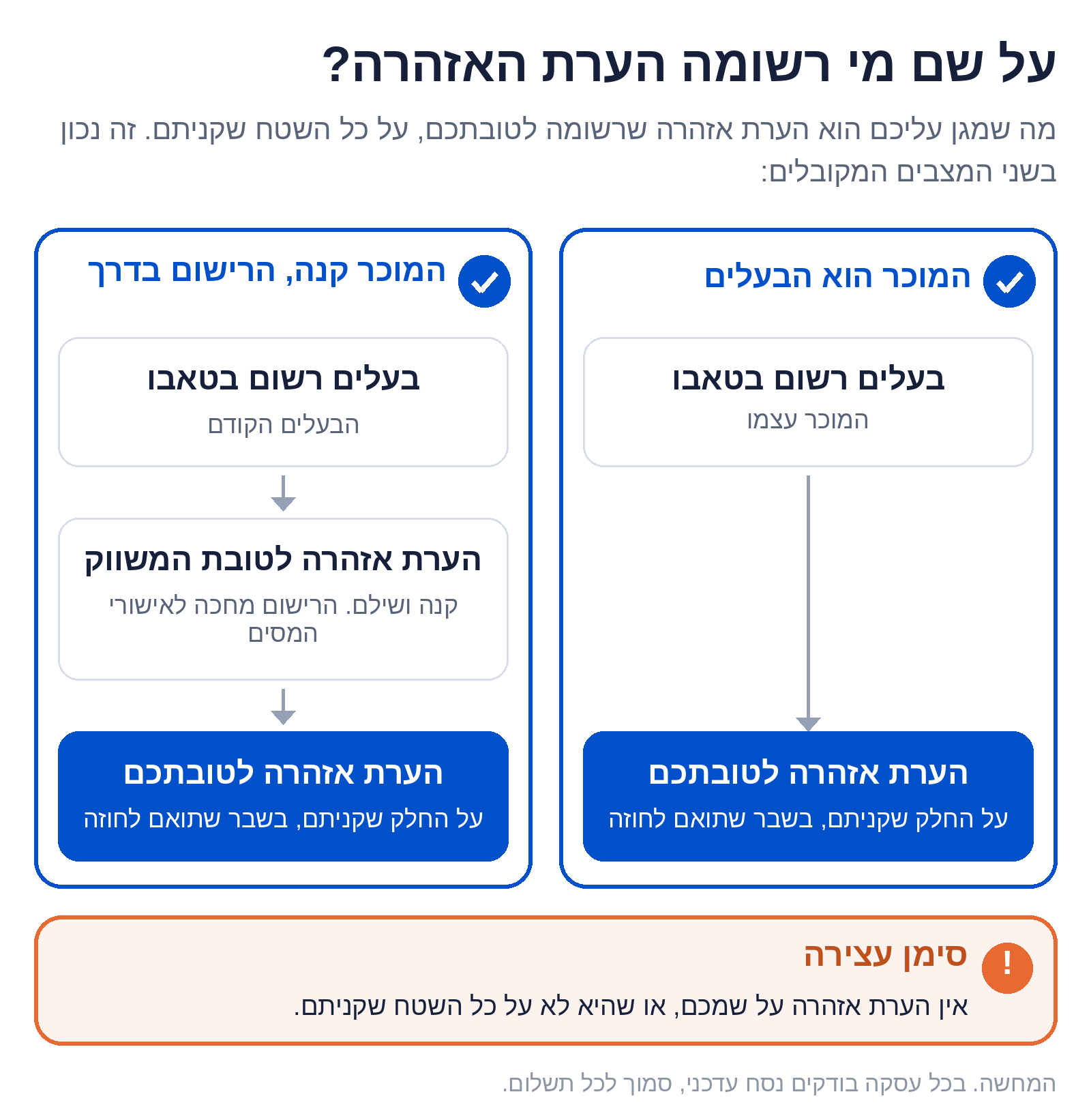
- In whose favor
- Your names appear in the extract as the parties in whose favor the note is registered.
- On whose rights
- The person selling to you is listed in the extract as the owner of the share, or as the holder of a warning note on it after buying and paying for it, until ownership is registered in their name.
- For how much
- The share in the note matches the m² in the contract, covering the entire area you bought.
A real case: ₪785 thousand and no land
In June 2023, a couple bought 100 m² in undivided co-ownership (musha) in an agricultural parcel, for ₪785 thousand. The company that sold to them was not the owner. All it had were two warning notes in its favor, on the rights of another person who was registered as the owner.
The contract stated that a note in the buyers' favor would be registered within three days. It was registered late, at first for only 80 m², and was corrected to 100 m² only in September. Later, all the notes were deleted using a power of attorney the buyers had signed, which was meant to be used only if they failed to pay. They had paid in full. In the meantime, notes from the tax authorities were also registered on the land because of debts.
In January 2025, the buyers canceled the deal. The Tel Aviv Magistrate's Court ruled that the cancellation was lawful and ordered the companies, and the manager personally, to return their money. For more risks in this kind of purchase: Land investment risks.
Lessons from the case
- What protects you is a note registered in your favor, covering the entire area.
- Pay only after the note in your favor is registered.
- The power of attorney for deleting the note stays with a trustee and is used only in the situation set out in the contract.
- Check the extract again after payment as well.
Power of attorney for deleting the note
In many deals, the buyer signs a power of attorney that allows the note to be deleted if the deal is canceled, for example if the buyer did not pay. This is common practice, but it is also the tool that was used to delete the notes in the case above.
What the contract should specify: who holds the power of attorney (preferably a lawyer acting as trustee, not the seller), in which cases it may be used, and that you are notified before it is used.
ILA land
On land managed by the Israel Land Authority (ILA), the rights are not always registered in the Land Registry (Tabu) in the holder's name. The ILA does not allow warning notes or liens to be registered on rights that have not yet been registered in the Land Registry, nor does it allow registration of joint ownership or a co-ownership agreement between the rights holders in the parcel.
In such a case, you request a confirmation of rights from the ILA. It shows who holds the rights and what is registered on the property, and costs 81 ₪ through the personal area on the ILA website.
After ownership is registered: alerts from the Land Registry
The Ministry of Justice runs a free service called Tabu-Net. Holders of registered rights receive an alert by e-mail or on their mobile phone about every registration action on their property, for example a warning note registered on the basis of a forged power of attorney. The alert does not prevent the registration, but it allows you to contact the Land Registry Office immediately.
Checklist: a warning note before every payment
- 01Obtain an up-to-date extract. Before signing, and again before every payment.
- 02Check who the seller is in the extract. And if the seller is registered only as the holder of a warning note, check that they paid the owner the full consideration.
- 03Check the parcel in ERRA Analytics. Look up the block and parcel, see the plans that apply to it and the transactions made in it and in the surrounding area, and compare them with the price you are being asked.
- 04No notes or attachments in favor of others. On the share you are buying, including notes from the tax authorities.
- 05The contract sets a deadline for registering the note. And the money is held in trust until it is registered.
- 06The note is registered in your favor, covering the entire area. The share in the note matches the contract.
- 07The power of attorney for deletion is held by a trustee. And the contract specifies when it may be used.
- 08Check the extract afterwards too. Every few months, until ownership is registered in your name.
FAQ
Who registers the warning note?
Usually the buyer's lawyer, immediately after signing. The application is filed at the Land Registry Office, or online through a lawyer.
Does a warning note (he'arat azhara) transfer ownership to me?
No. It protects your right until the transaction is registered. Ownership passes only when the transaction itself is registered in the Land Registry (Tabu).
Does a warning note expire?
No. As long as it is registered, it is not subject to a limitation period. It is removed with the consent of the parties, by court order, or when it is proven to the Registrar that its grounds are void.
Can a warning note be registered on a share of land held in undivided ownership (musha)?
Yes. The note is registered on the seller's share, together with the portion of the parcel the seller undertook to transfer to you.
What do you do when the seller is a company that is not yet registered as the owner?
This is a common situation. Usually the company has already bought and paid, and registration of ownership in its name is awaiting tax clearances. Check whom the company bought from, and make sure a warning note is also registered in your favor over the entire area you bought. It is advisable to consult your own lawyer before making any payment.
Summary
A warning note secures your place in the land until ownership is registered. It is registered in your favor immediately after signing, and you pay only once it is registered. The information in this article is general and is not legal advice.
Further reading and tools on the site
Articles
- Land Registry extract: how to read it
- Co-ownership agreement for real estate
- Risks of investing in land
- Appraisal standard 22: how to read an appraisal
- Guide to buying land for investment
Tools and pages
- ERRA Analytics: all plans and transactions on every parcel
- Land profit calculator
- Our projects
- Properties for sale
Sources
- 01Ministry of Justice: Application to register or cancel a warning note
- 02Ministry of Justice: Tabu-Net, alerts on activity in a property
- 03Israel Land Authority: Actions for registering or updating rights in the Land Registry
- 04Israel Land Authority: Confirmation of rights
- 05Land Law, 1969, Sections 126, 127 and 132
- 06Kol Zchut: Warning note
- 07Merkaz HaNadlan: Warning note, the complete guide
- 08Bizportal: They paid 785 thousand shekels for land, and then discovered they have nothing
- 09ynet: Supreme Court approves deletion of buyers' warning notes in a company in liquidation