- 0 ₪
- Cost of checking a plan on the Planning Administration website
- 60 days
- To file an objection from the date the deposit is published
- 3
- Main documents: provisions, plan map, appendices
Where to check
The Planning Administration has two tools open to the public, free of charge. A third tool brings this information together on one screen:
- Find plans, meetings and appeals
- Search the planning database by plan number or subject. The plan page shows its planning information, and you can also see agendas, minutes and decisions of the district and national committees.
- XPLAN, "blue lines"
- A map of online plans. Search by number, name, housing units, land designation or address, and click a plan to see its processing stages, minutes and documents. The data is updated once a day, and only detailed plans appear in it.
- ERRA Analytics
- Search by block and parcel, city or address. See on a single map the plans that apply to the parcel, their status and designation, together with transactions in the area, with a link to the plan in the Planning Administration's system. You can start for free: erra-analytics.co.il.
Checking land yourself, step by step
Here's how to check land yourself, free of charge. On ERRA Analytics you see the whole picture on one screen, and on the Planning Administration website you verify what you found.
- 1Ask for the block, parcel and plan number
From the seller, the contract or the appraisal. A serious marketer knows them. If there is no plan number, no plan has been submitted yet.
- 2Open the parcel in ERRA Analytics
Search by block and parcel, city or address. See the parcel on the map, with registration, boundary and planning layers.
- 3Check which plans apply
On ERRA Analytics you see the plans that apply to the parcel, and the status and designation of each one. Check that the plan the seller is talking about is on the list.
- 4Check prices in the area
On ERRA Analytics you see transactions reported in the same block and nearby, and the trend over the years. Compare them with the price you're being asked to pay.
- 5Verify on the Planning Administration website
Go to the plan page in the planning database: check the blue line on the plan map (tashrit), the processing stages and the latest decision.
- 6Read the provisions
What the designation of your part is, how much may be built, and whether there is reparcellation (ihud vehaluka).
What you see on the plan page
The fictitious example below marks the five things to check on a plan page.
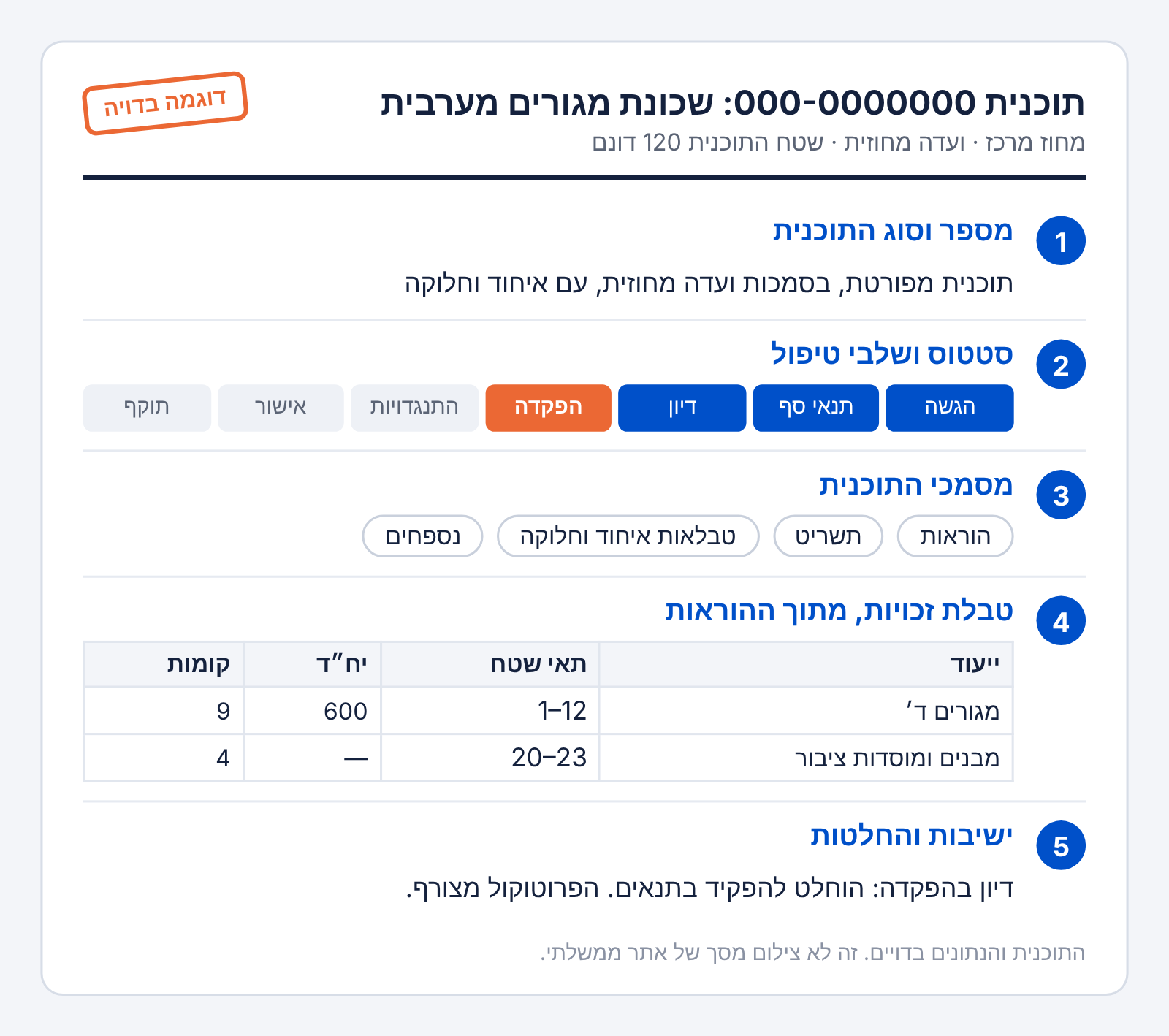
1. Plan number and typeWhether it is an outline plan or a detailed plan, and which planning institution approves it: the local or the district committee. A building permit can only be obtained under a detailed plan.
2. Status and processing stagesWhere the plan is along the way: submission, discussion, deposit, objections, approval or entry into force.
3. Plan documentsThe provisions are the binding text. The plan map is the map. A plan that includes reparcellation also has allocation tables.
4. Rights tableThe provisions include a table with the land designation, the plots, the building volumes, the height, the building lines and the number of floors.
5. Meetings and decisionsThe minutes show what the committee decided and which conditions it set. This is where you find out whether the plan has stalled.
What each stage means
| Stage | What it means for the buyer |
|---|---|
| Submitted, threshold review | The plan has only just set out. It can still change significantly or be rejected. |
| Deposit hearing | The committee decides whether to deposit the plan, deposit it subject to conditions, or reject it. |
| Deposited | The plan has been published to the public, and objections can be filed against it. It is not yet approved. |
| Hearing of objections | The committee considers the objections and may change the plan. |
| Approved | The committee has decided to approve the plan. The plan takes effect only after publication. |
| In force | The plan is binding. If it is a detailed plan and no further reparcellation is needed, you can apply for a building permit. |
In one sentence"There is a plan" does not mean "you can build." Only a detailed plan that is in force allows you to apply for a building permit.
On all seven stages agricultural land goes through until building on it is permitted: Land re-zoning: the 7 stages. And on what happens to your parcel when the plan includes reparcellation: Reparcellation.
Objecting to a plan
Anyone who believes a plan harms them may file an objection within 60 days of the date the plan is published. For plans where it has been decided to extend the deadline, objections may be filed for up to three months. For Planning Administration plans, objections can be filed online after identifying yourself on the government website.
Checklist before you buy
- 01There is a plan number. And it appears in ERRA Analytics on your parcel and in the Planning Administration database.
- 02The parcel is inside the blue line. Check against the block and parcel in the Land Registry extract (nesach tabu).
- 03The stage is known. The status in ERRA Analytics and on the Planning Administration website matches what the seller told you.
- 04The price makes sense. You have checked in ERRA Analytics what parcels in the same block and in the surrounding area sold for.
- 05The designation is clear. Check in the provisions and the plan map what is planned for your portion: residential, a road or a public building.
- 06Read the latest decision. In the minutes of the most recent hearing, including the conditions.
- 07Compare with the appraisal. For land that is not available for construction, an appraisal standard 22 valuation must describe the same planning status.
On the appraisal: Standard 22: how to read an appraisal of land not yet approved for construction. And on the extract: Land Registry extract: how to read it.
FAQ
Does checking a plan cost money?
No. Searching the planning information database and XPLAN is open to the public free of charge, and ERRA Analytics has a free plan.
What is the difference between depositing a plan and approving it?
When a plan is deposited, it is published so the public can file objections to it. At approval, the committee decides to approve it, and once published it comes into force.
I found a plan, but my land isn't inside the blue line. What does that mean?
It means the plan does not apply to your parcel. Ask the seller which plan they are relying on, and check it.
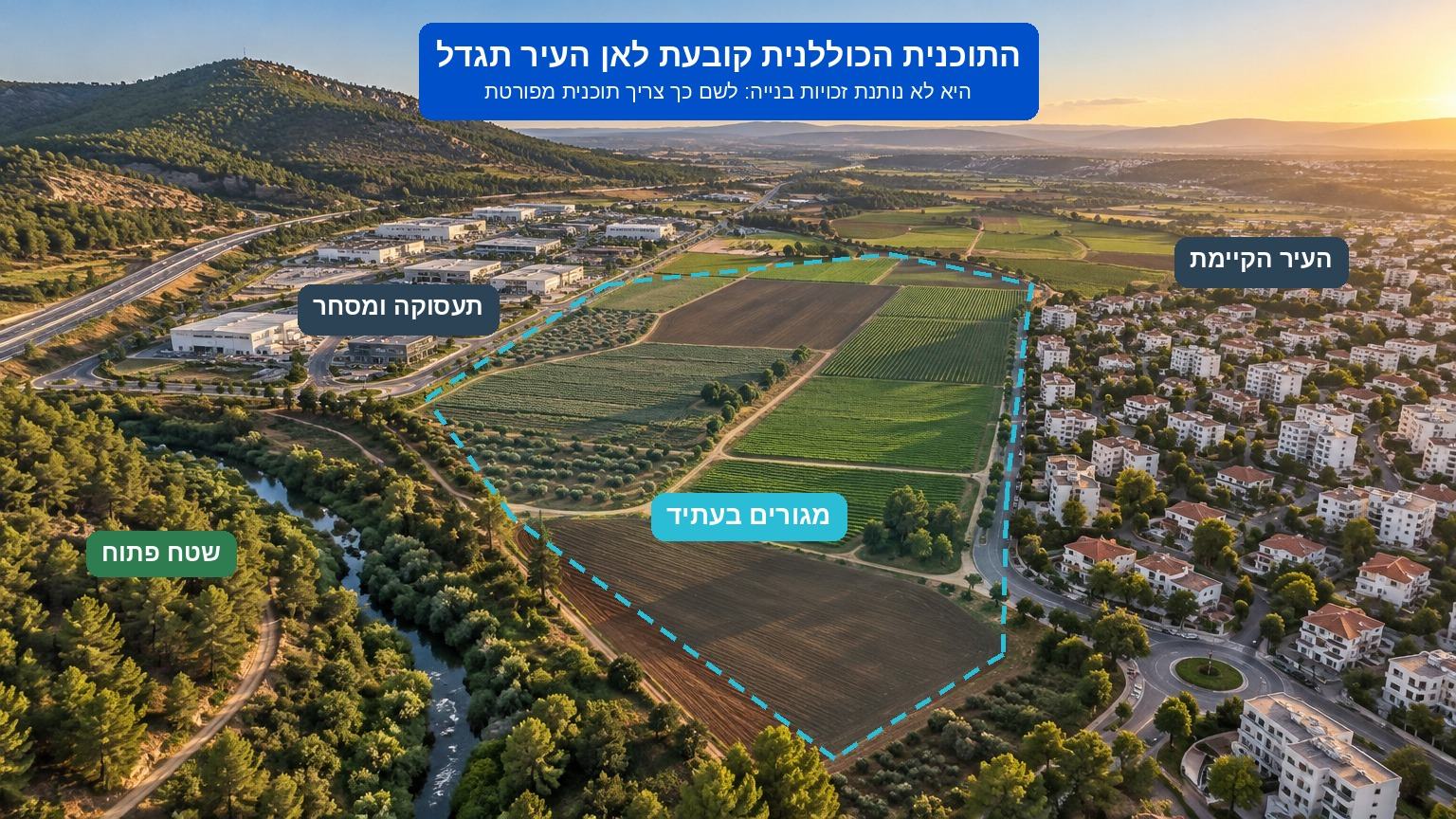
What is a comprehensive outline plan?
A plan that sets the direction for the development of a town or area. Usually, a building permit cannot be obtained on the basis of it, and a detailed plan (TABA) is also needed.
Is what's written on the website binding?
The website is a source of information. If there is a conflict between the information on the website and the provisions of the law, the law prevails. Before a transaction, it is advisable to also check with an appraiser or a lawyer.
Summary
Checking a plot of land yourself takes a few minutes and costs nothing. Open the block (gush) and parcel (helka) in ERRA Analytics, look at the plans, their status and the transactions, and verify everything in the Planning Administration's database. Check that the parcel is within the boundary, what stage the plan is at, and what its provisions permit. The information in this article is general and does not constitute legal or planning advice.
Further reading and tools on the site
Articles
- Change of land designation: the 7 stages
- Appraisal standard 22: how to read an appraisal
- Land Registry extract: how to read it
- Reparcellation
- Guide to buying land for investment
Tools and pages
- ERRA Analytics: all plans and transactions on every parcel
- Land profit calculator
- Our projects
- Properties for sale
Sources